Showing posts with label Robert Kaplinsky. Show all posts

Monday, April 18, 2016

2016 #NCTMannual reflection: Purpose

There is a lot to process from NCTM 2016. Being a contributor for the Global Math Department this week, I decided to feature snippets on the blog here in order to kill two birds with one stone.

I found it useful to connect all the NCTM goodness with a theme: PURPOSE.

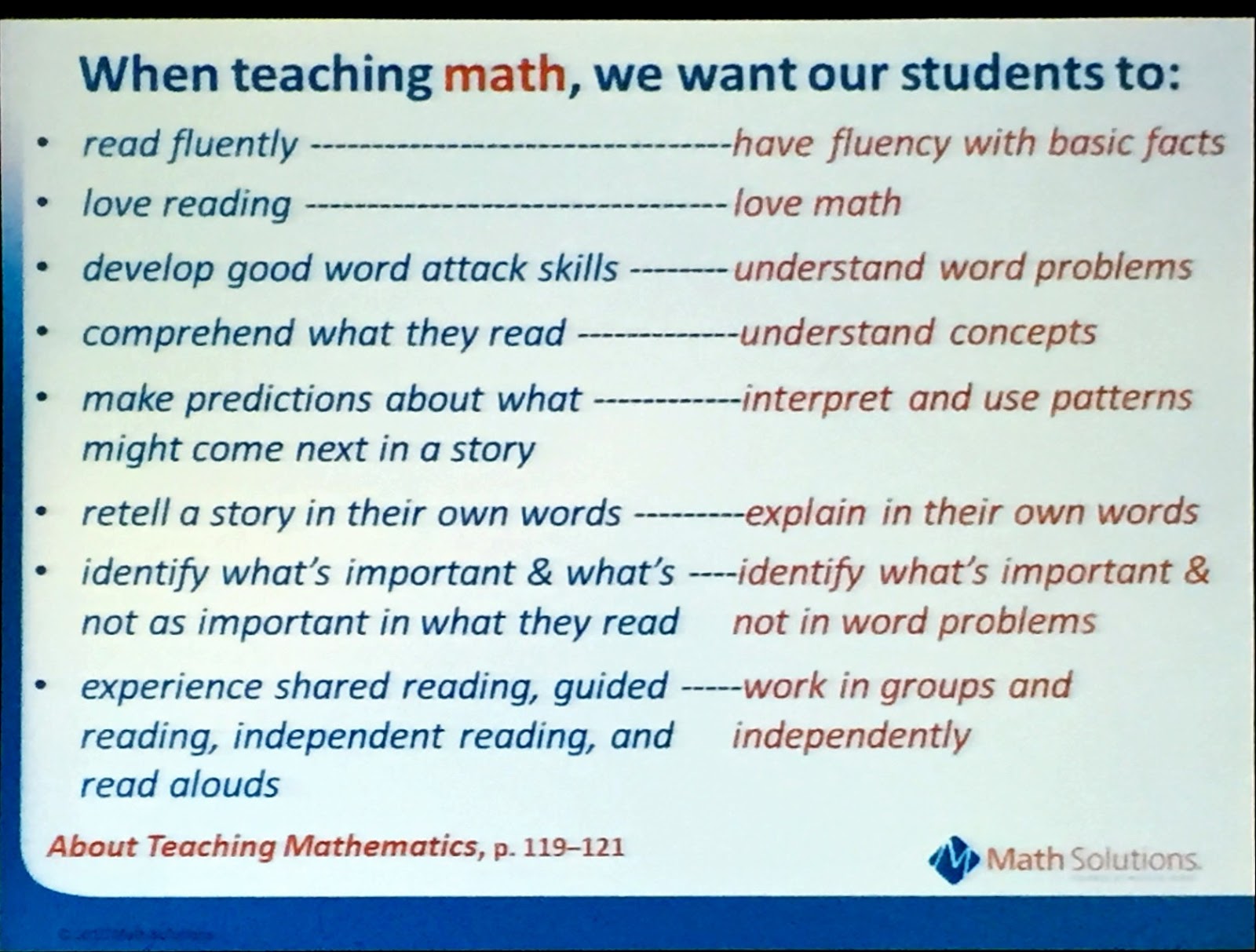
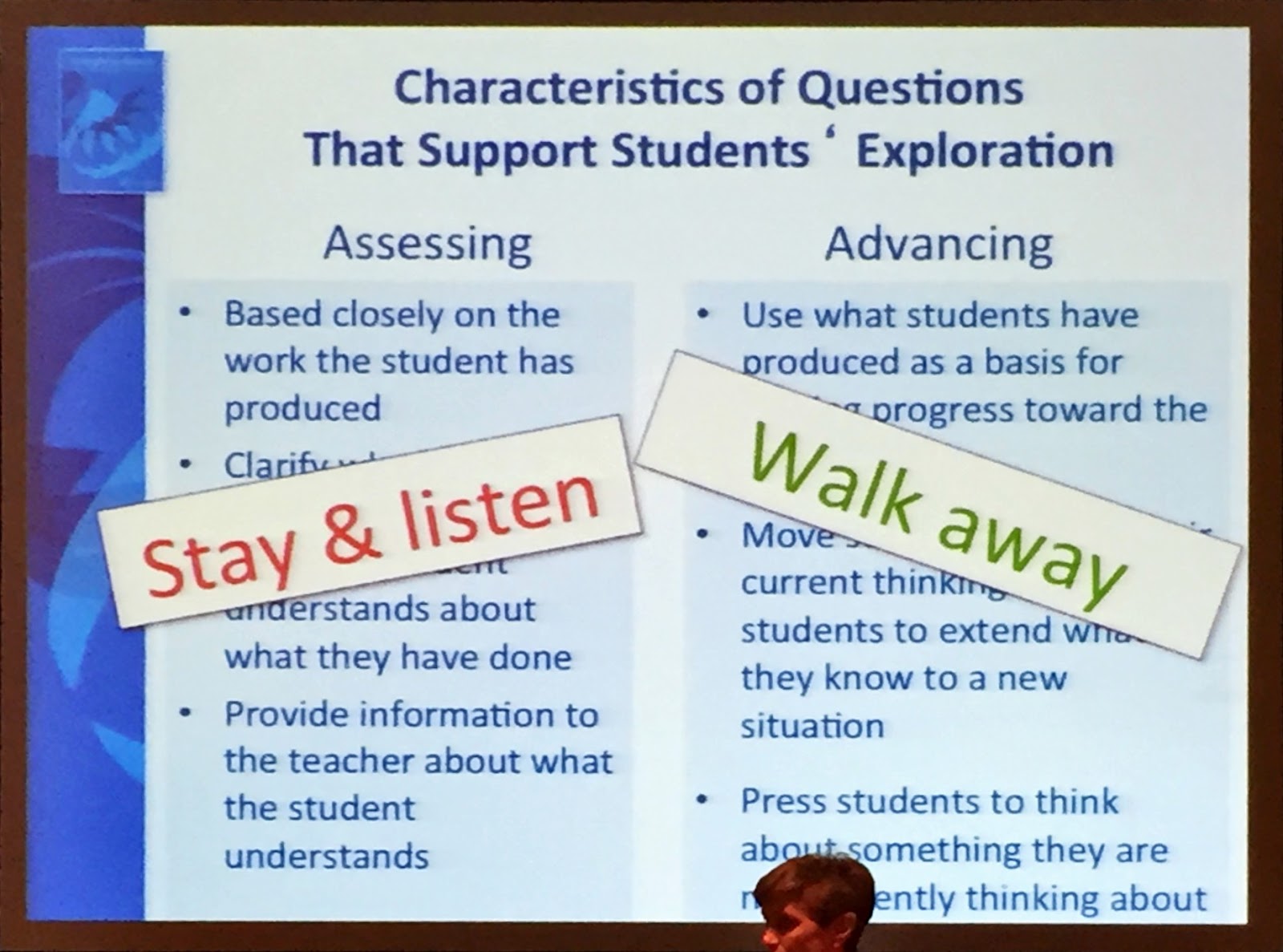
• Marilyn Burns (@mburnsmath)
Be purposeful about what we want our students to do. I loved this slide, connecting reading and math:
• Christopher Danielson (@Trianglemancsd):
Be purposeful with knowing the ability of students. Christopher said,
"Students can. We should let them."
This idea lends itself to students discovering properties in math. Often, when things get discovered in math, they are named after the discoverer. Why don't we do this more with students?"
Goods here.

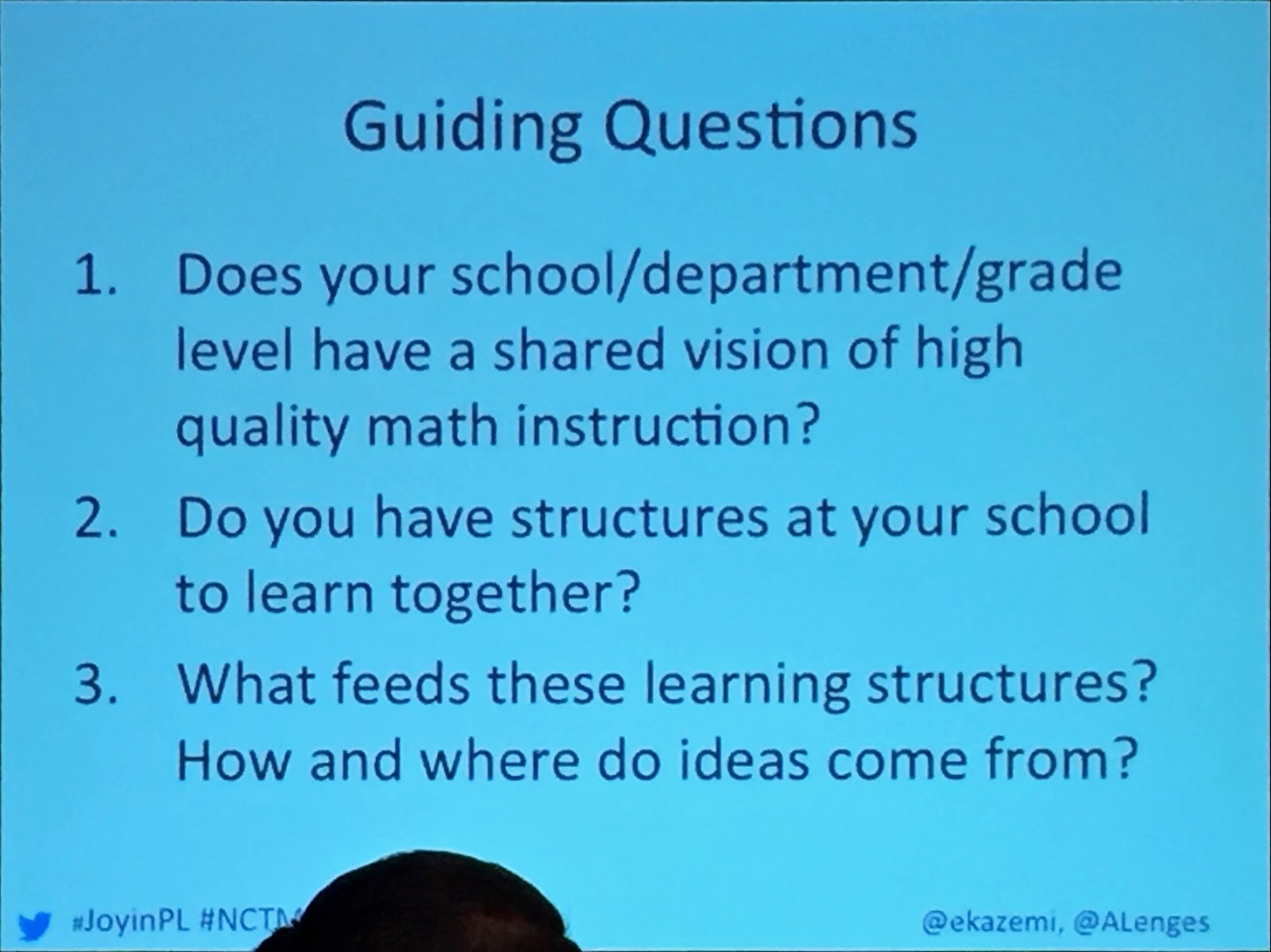
• Elham Kazemi (@ekazemi):
Be purposeful with a school/department/grade having a shared vision of quality math instruction. Create a structure at your school to learn together. We went on to explore numberless word problems where the purpose is to help students make better sense of the context before applying the numbers. She shared this post by Brian Bushart.
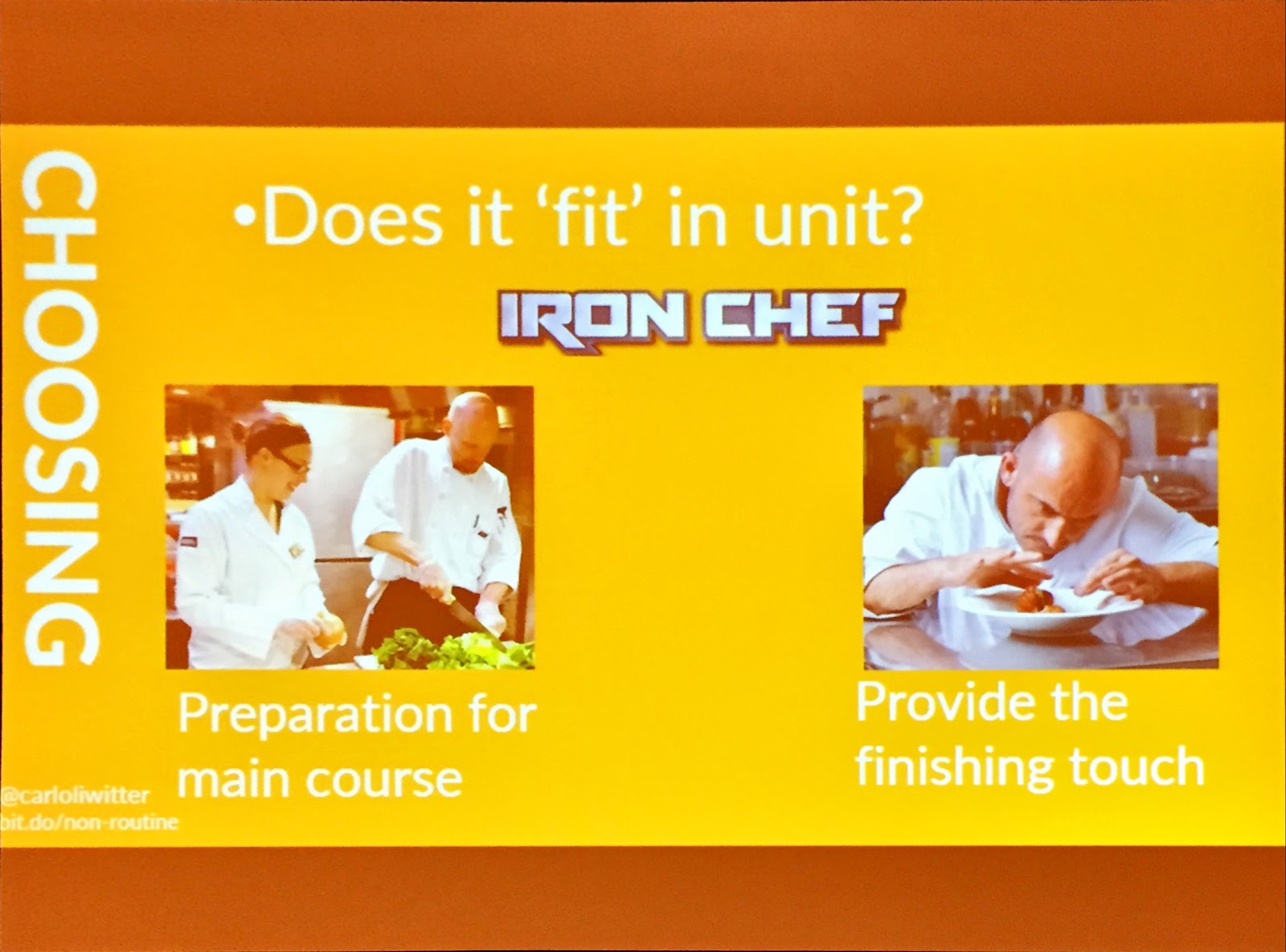
• Carl Oliver (@carloliwitter):
Be purposeful with the space you provide students to explore mathematical ideas. Be purposeful with selecting the task.
Goods here.
• IGNITE talks:
Max Ray (@maxmathforum):
Be purposeful with the resources, tasks, activities, and ideas you pull from the internet. Be purposeful with the coherency in your teaching. Do the resources, tasks, activities, and ideas you pull from the internet add to the coherency of the mathematics you teach?

Jennifer Wilson (@jwilson828):
Be purposeful with the time you allow students to solve math. It's not like fast food, it's like slow food. Enjoy the math students can do when we make it a purpose to do #slowmath.

• ShadowCon16
Kaneka Turner (@KanekaTurner)
Be purposeful in making math a social experience by inviting others into this awesome experience. Kaneka shared the importance of being invited. Call to action: invite at least one person to be part of the math experience.

Robert Kaplinsky (@robertkaplinsky):
The purpose of empowering others through influence can have huge positive results. Robert shared a couple of personal parts on his life and how influential people throughout his life have helped shape who he is today. Call to action: your your power to influence and empower others.

Graham Fletcher (@gfletchy):
Be purposeful in knowing what/how you teach by understanding the standards. Be a better story-teller in your classroom by accurately knowing the standards. Call to action: find out more about a standard you teach.

• Brian Shay (@MrBrianShay):
Be purposeful with polynomials and probability. Brian had us working on using spinners and coins to add meaning to multiplying polynomials.
Goods here.

• Peg Smith:
Be purposeful in framing the task so it "invites everyone in." Furthermore, ask purposeful questions when working with students during problem-solving tasks. Lastly, it's critical for the teacher to explain the goals because it's hard to have a conversation if it's unclear what you're trying to accomplish.
***Let's invite Peg to the #MTBoS and Twitter.
• Andrew Stadel (@mr_stadel):
Be purposeful in the feedback we give students after they make mistakes. Thanks to Robert Berry and Dylan Wiliam, I shared with teachers the importance of providing feedback that benefits students and at the same time challenging them to take traditional feedback and rework it so it's better at moving the learning forward.

• Christina Tondevold (@BuildMathMinds):
Be purposeful in working toward the terminology in the standards, specifically "fluently" and "using strategies" in the K-5 standards. We looked at examples of subitizing, cardinality, and strategies like making ten, double-plus-one, finding fives. We need to be purposeful in students making sense of math for themselves.

• Jason Zimba
Be purposeful in decluttering what we teach, what we ask of students, and what we give to students. Something he got me thinking about: do we Math 8 teachers need to teach the "elimination" process when solving linear systems. Does the procedure support the conceptual understanding? and can we allow high school teachers to teach it while Math 8 teachers focus on graphing and substitution?

I hope to see you at NCTM 2017 in San Antonio.
Send in a speaker proposal here by May 1, 2016.

San Fransisco,
2016


Sunday, December 6, 2015

Productive Struggle [part 1]

I want to know more about "Productive Struggle".

Let me be more specific:
If students are allowed to reasonably struggle with a math task, I want to know more about a teacher prescription of actionable steps to:
  • move the learning forward and 
  • avoid a meltdown level of frustration
I built a Productive Struggle Desmos Activity if you would like to share your thoughts and learn from others interested in this topic.

Robert Kaplinksy recently gave a wonderful Ignite Talk on Productive Struggle. Communication was a big part Robert's message. I want to think more (in part 2) about communication as one of the actionable steps in that prescription.

Struggle,
1128

Part 2 is here.

Sunday, May 3, 2015

The Ultimate Task for Vertical Planning: Stacking Cups

This past week, I submitted a speaker proposal for NCTM 2016 in San Fransisco. The proposal is for a Grade 6-8 Burst (30 minutes) with the exact same title as this blog post: The Ultimate Task for Vertical Planning: Stacking Cups. I figure if I don't get accepted, at least I can share my thoughts here and you all can help spread the word about my idea if you think it has potential. If it does get accepted, I look forward to giving an update a year from now at NCTM. Here's my session description:
Who says you can't use the same task each year? Come see why Stacking Cups might be the single best secondary math task to get teachers at your school, district, or state to see the importance and necessity of vertical planning. Use tasks that utilize connections from the previous year and extend the mathematics each year. Work smarter, not harder. 
Let's first back up a bit. I attended Alex Overwijk's session at NCTM Boston a few weeks back. I had already read his awesome blog post "Open Strategy Cup Stacking" and knew there are multiple teaching moments with Stacking Cups. I remember teaching Math 8 a few years ago and getting a lot of use out of Stacking Cups as you can see a couple times here and here. I was preparing for a training with math teachers from grades 6-12 and THAT's when it hit me: I could have a room full of math teachers from grades six through twelve and they all could:
  • be working on this task
  • see the different skills and tools necessary for solving
  • know the expectation of each grade level
I've heard comments from teachers numerous times like, 
"Well, if they do File Cabinet in 6th grade, I can't do it in 7th grade with my students."
"If they've done Stacking Cups in Math 8, then I can't do it in Algebra."
"If the 5th grade teachers use Estimation 180 with students, then I can't." 
YES! YOU CAN! It's called vertical planning.

YES, YOU CAN! Instead, let's ask different questions like, "How can we use the same task to extend the mathematics each year?" and  "How can we make connections to prior learning from the previous grade level?"

Let's work smarter, not harder.

I will spend the rest of this blog post highlighting each grade level and suggested uses for Stacking Cups. It won't be complete or the final version as this is through the lens of one person. I'm confident, with your help and critique, we can make it even better.
Math 6
Question: How many cups do we need to stack (alternating) to reach someone's height?
We talk about rate. We organize our information on a number line, in a table, using a tape diagram, etc. We explore the rates using various models.

Math 7
Question 1: How many cups do we need to stack (alternating) to reach someone's height?
We continue the conversation started in Math 6 revolving around rates, using constant of proportionality. All of this can be represented in a table, as an equation, and in a coordinate plane.

Question 2: How many cups do we need to stack (consecutively) to reach someone's height?
We now shift our thinking a bit where there is still a constant increase with each cup, but there is an initial amount (the cup handle). Students explore how to write an equation to represent this situation and solve it.

Question 3: What would be possible dimensions of a box that would contain the cups to stack to someone's height? Which dimensions would be the most cost effective?
Imagine students understanding surface area and volume and how they're related to each other, especially if we model with mathematics, by identifying variables such as:
  • cardboard cost
  • delivery truck capacity 
  • store storage sizes
  • consumer trends with buying cups
  • more

Math 8
Question 1: How many cups do we need to stack (consecutively) to reach someone's height?
Similar to question 2 in Math 7. However, we extend the mathematical understanding as we explore constant rate of change (slope), input and output, linear, and how our situation can be represented in the form y = mx + b.

Question 2: When will two stacks of different sized cups be equal in height and have the same number of cups in each stack?
We introduce students to linear systems using this task. Students can organize the information about each cup in a table. We can extend prior knowledge to represent the situation using graphs, equations, and functions.
*By the end of Math 8, it might be helpful to mention (at least informally) to students the significance of discrete functions.

Algebra
We tighten up the math (both questions) previously learned in Math 8. How can we extend the mathematics. Add more challenging situations like the stacks start on different objects like desks, boxes, etc.
Question 3: How many cups would we need to stack in a triangular formation to someone's height?
This questions really extends the mathematics for students, but we can still use the tools they've learned from previous grades. Maybe students start by organizing the data in a table. Maybe they graph the data and notice it isn't linear. Maybe we can use desmos with sliders or a line of regression to explore quadratics.

Beyond Algebra and Geometry:
I'll admit this is where I'm a little rusty and would need you high school pros to jump in and contribute. I think with the triangle stacking, it can be taken from quadratic to a divergent series. I've also seen high school teachers come up with the following representations:

Al Overwijk also stacked cups in a triangular pyramid which is awesome.

Let's keep this vertical planning going. If you would like a couple charges, here you go:
Go to your site and/or district and push for Stacking Cups to be a signature task at all sites and secondary grade levels. Help support your colleagues with vertical planning. Report back.
Look for other tasks out there like Robert Kaplinsky's Hot Dogs or Dan Meyer's Penny Circle or Mathalicious' Wheel of Fortune or Graham Fletcher's Water Boy that can be used with vertical planning. Report back.
Vertical,
432


Sunday, March 8, 2015

A Jammed Rational-Irrational War, Stacking Cups Week

Some cool stuff happened this week. Well at least I think it was cool.

Monday: 
One of my math fellows was observed by other math teachers from our district. He was starting a new unit with rational and irrational numbers, focusing on 8.NS.1 and 2. I might be wrong, but pretty dry stuff… here’s how we spiced it up a little.

We did a pre-assessment using the Post-It Plus app. Yes, my obsession with Post-It notes has gone to a new level: digital. We created a file within the app, posted it on his Haiku calendar, and had the students download the file into their app on their iPad. 

Students first worked individually to sort the terms from least to greatest for a few minutes. Since his students are grouped in fours, they then narrowed it down to one iPad screen they thought was most accurate. (Quick demo)

*Reflection: we should have had students paired up first, discuss, and narrow it down to two screens for the entire group. Next, the whole group of four students would discuss and narrow the two iPad screens down to one screen for the group.

Once each group settled on a screen they felt most confident with, they took a screenshot and uploaded their group’s screenshot to the Padlet page my fellow created for them.

My fellow used this Padlet page to assess the overall climate of the class (without teaching them a single thing). He used this real-time data to have some really rich conversations and share-out of ideas from students.

Remember to tell students:
  • It’s okay if you’re wrong. 
  • Make your best guess.
  • I just want to see what you already might know.
Flash forward to Friday:
The previous weekend I asked the same fellow what he thought about playing War with rational and irrational terms. Side note: I play a few card games with my young son and one of them is War. My fellow thought the idea was epic. He ran with it. Here how he made it awesome:
  • He made these awesome cards.
    • Some values had multiple representations
  • Printed them out on card stock.
  • Made a graphic organizer for students.
  • Each group of four was broken down like this:
    • 2 people played War while the other 2 people recorded and were the judges.
    • The next round, the roles were switched.
  • There were 3 rounds.
  • Each round was 6-10 minutes
  • He stopped class and made a spectacle whenever two students were at war.
  • The third and final round was between the winners of the first two rounds.
I asked if I had his permission to share the cards and he said, “Sure.”

Tuesday:
Another fellow asked me to model Stacking Cups in their first period class, which ran less than 45 minutes. My fellow requested I complete the task with students in one period. I explained that I’ve never “finished” the task in one period because there is so much to explore and learn in the task. I respected the request and  tried to cram it into one period. I spent too much time launching the task. 

Act 2 (the best part) felt rushed and we still didn't finish. My fellow and I debriefed and made some adjustments so she could finish it with her next period. She stuck to the adjustments and did a fantastic job facilitating the task. The students were doing awesome and amazing math during Act 2… and what do you know? The class was over. I love that my fellow was going to revisit the task the next day. Could we have spent another day on the task? Yes. It’s a starting point and I’m very proud of my fellow for trying out something new and doing a great job. I’d say the sweet spot would be one-and-a-half days for this task...
*Side note: I encourage you do styrofoam cups earlier in the year, and use Stacking Cups throughout the entire linear systems unit.

Thursday:
Another teacher wanted me to model Stacking Cups as well. When we sat down to plan, she was totally cool with spending one-and-a-half days on the task. Great news!
I launched the task, used a Padlet page to capture what they noticed. I asked the question, "Where will they tie?" and used a Google form to collect their guesses (see my post on using Google forms to collect student thinking). 

We gave each group only 4 white styrofoam cups. Students were making tables, or writing equations, or some were even wanting to graph their equations. Interesting note: some students started their table with zero cups having a height of 9.2 centimeters. The teacher had only taught graphing systems, so students were already thinking ahead to substitution. It was awesome. She did a wonderful job facilitating her first 3-Act task. We didn’t finish the task in one period, but it felt right knowing we had another half-day to wrap up the task. 

Back to Friday:
After work, I started putting the meat in my upcoming session, Math Mistakes and Error Analysis: Diamonds in the Rough. Although I will be showcasing a couple ways I’ve had success with error analysis with students, I love that I’ll be showcasing some awesome work and contributions from:
Hope to see you in my upcoming session as we explore why error analysis is important to:
  • help drive instruction
  • curb student misconceptions and
  • strengthen formative assessment. 


Hope your week went well too. If not, hope this week is better.

Rational/Irrational,
516


Thursday, January 1, 2015

Thank You 2014

There are many parts of 2014 for which I'm thankful. Here are some math-related ones.
*Apologies if I missed someone or something. Please remind (badger) me in the comments.
  • YOU for reading this blog, giving me feedback, sharing ideas, making suggestions, attending my conference sessions, sharing stories about using tasks or Estimation 180, and being in education to support students (children and adults).
  • The MTBoS for helping me continue to grow as an educator.
  • TUSD for having confidence in me as a coach to support fellow math teachers.
  • TPSF for allowing me to contribute to such an amazing summer learning environment. 
  • DLCs and Co. for being a great bunch of tech-junkies in the name of meaningful learning
  • Conferences:
    • GLAMC for being wonderful people, organizing great mini-conferences, and gathering wonderful Los Angeles teachers.
    • OCMC for hosting highly accessible and meaningful PD opportunities in Orange County throughout the year. 
    • NCSM for allowing me to nerd out with Chamberlain and Kaplinsky in New Orleans.
    • NWMC for a jam-packed conference of sessions in which multiple states and countries can partake in.
    • CMC for holding the best conferences in the biz. I was truly honored to be a small part.
  • Consulting:
    • PYLUSD, Rockwood, and CUSD: thank you all for your confidence and willingness to have me work with your math teachers. I learned a great deal!
  • Christopher Danielson for sending me a wonderful estimation book (still reading).
  • Tracy Zagar for including some Estimation 180 in her upcoming book.
  • Motion Math for making wonderful-amazing-delightful math apps for my son and me to enjoy together.
  • Eric Milou, Gwen Zimmerman, Robert Kaplinsky and Dan Meyer for putting up with me during our NCSM 3-Act project and allowing me to learn a great deal from you all. 
  • Hannah for being the best colleague last school year.
  • My niece for designing the Estimation 180 logo and artwork.
  • Johnny and SPEYSYDE for helping me get my Estimation 180 shirts printed.
  • Steve Leinwand for the continued inspiration and top-notch CCSS elevator speech about MP3.
  • The Math Forum and the Encompass crew for the continued opportunities to connect, collaborate, and create in the name of problem-solving.
  • CueThink for creating a digital problem-solving app to support students and teachers.
  • Global Math Department for allowing me to frequently write a short blurb in their newsletter.
  • Kaplinsky for being a great (math) friend and coercing teachers to ask for sticky note autographs.
  • Fawn for still making fun of me.
  • My students for teaching me.
  • My family for your love and support that encompasses everything.
Thank you,
123


Sunday, June 15, 2014

A Few Updates

Update 1:
I finally finished Act 3 for my Deodorant lesson. I hope you check it out and can give me some feedback; I think it could be much better with your help. If nothing else, check out how long it took to use 5 sticks of deodorant. Mathematical Modeling should really be at the forefront of this task. It might appear linear, but I would bet a year's supply of deodorant that an adolescent's deodorant use will be far different than mine. I also guarantee students will think of variables ranging from climate to age to geographical location to genetics to more. I think you'll have some excellent conversations with the deodorant task. My favorite part is the sequel: How many sticks of deodorant would one use in a lifetime?

Way back when this task first started, I opened up a little estimation competition in the comments at 101qs. Don't listen to a word Nathan Kraft says. The person with the closest guess would win an Estimation 180 prize. With so many close estimates, the following gentlemen will be the first to receive the new Estimation 180 stickers, hot off the press!

Congratulations to:
1st place: Chris Robinson (May 14, 2014)
2nd place: Robert Kaplinsky (May 5, 2014)
2nd place: Michael Fenton (May 15, 2014)
3rd place: James Cleveland (May 3, 2014)

Update 2:
Estimation 180 will be getting a facelift and other updates over the summer. Here are a few things to look out for:
  • New logo
  • New fields for entering student estimates
  • Clean spreadsheets containing "other estimates"
  • Updated Lessons
  • Search by Categories
  • Sentence frames for student reasoning
I'm most excited about the last update; sentence frames. I occasionally browse over student responses and notice many students entered "I guessed." I think it would be extremely helpful for teachers to provide their students with sentence frames in order to better articulate their reasoning. I will be focusing on this tool in upcoming presentations and workshops.

The new logo was done by my niece. I love her simple design, the two 180 degree arrows, the metric reference, and her idea to transform me into a stick man. That reminds me, I still owe her a pizza!

I hope to get a few t-shirts made too. You can sport them at your next PLC, department meeting, casual Friday, or math conference. Any takers?

Update 3:
I've accepted a Teacher On Special Assignment (TOSA) position with my district for next year. It's a bittersweet feeling at this point. On one hand, I'm very excited because I'll be working at various secondary sites throughout my district, collaborating with other math teachers, helping design lessons and implementing various technology. My official title will be a Digital Learning Coach. I hope to seek advice from people like John Stevens, who have been doing this for some time now. As I pack up my room, I already miss my own classroom and students. However, I look forward to learning a great deal from the teachers I will be fortunate to work with and the students I'll be able to interact with at each site.

Updates,
243

Friday, April 18, 2014

Get Students to Argue in Math Class

I recently submitted my speaker proposals for both 2014 CMC conferences. One of my proposals is for the following session:
Title: "Get Students Arguing in Math Class with Number Sense Activities."
Description: Get students to productively argue about math situations. Participate in number sense activities requiring students to construct viable arguments, critique the reasoning of others, and use sense-making. Get ready to throw down.

I also had to answer a few questions justifying the session and connecting it to the CCSS and 8 Mathematical Practices. I provided the following connection:
The presenter will use number sense activities to get participants to construct viable arguments and share their reasoning like students. Using presenter-made tasks (Estimation 180) and other online resources appropriate for grades 3-8, attendees will be able to see the importance of student reasoning and creating productive discourse in the classroom. Teachers will also be provided with sentence frames and stems for all students, especially English language learners.

I'm really excited at the thought of this session getting accepted so I figured I would jot down a few ideas here and see what you all have to contribute. Even if I'm not accepted, I think every math class has to have students productively arguing at times. Doing estimation challenges with my students has been so beneficial for them to get better at the art of arguing. However, I know it could be better. I'm not sure if you've ever experienced it before, but it's a treat to stand off to the side or in back of a group of students arguing about a question in math. They have no idea you're nearby because they are so caught up in the argument. Don't get me wrong, it's not like they're swearing at each other and calling each other names. They are having a rich discussion, sharing conjectures, examples, counterexamples, etc. and I have the pleasure of spectating. I usually turn to an innocent bystander (nearby student) and whisper, "Awesome, look at them arguing. Isn't it great?" The student usually looks shocked that I'm happy their classmates are arguing. I love it!

I'd like this session to place a big emphasis on two mathematical practices:
MP 3: Construct viable arguments and critique the reasoning of others.
MP 1: Make sense of problems and persevere in solving them.

I plan to break these two practices down more in my session. For now, I feel I need to focus on three major parts to arguments: having excellent content, capturing the arguments, and indirect facilitation.

Content: There's a wealth of content available, but I think the more controversial the point of contention, the better. One of my favorite moments in math class was when we did Mathalicious' Datelines lesson. Students were arguing about which celebrity shouldn't date another celebrity because of the age discrepancy. Some students disagreed about the rule of (n/2) + 7, especially since I was teaching 14 year-olds at the time. It was awesome.
Here's my current list of resources that have given my students great things to argue about:
My kids went nuts arguing about a similar question to this "Would You Rather" found here.

These don't have to be full-on lessons. They can be warm-ups, math talks, used during classroom transitions or to break up your direct instruction, etc. I'm really looking forward to using @MathCurmudgeon's site MathArguments180.com
Imagine your students arguing about which student should pack your parachute based on this data.
Another up and coming resource is Open Middle by Robert Kaplinsky and Nanette Johnson.

What resources would you add to my content list?

Capture: I need to capture these arguments for a few reasons. Students need to listen to other students argue, especially from different classes. My memory is very porous, and I can't remember what students say verbatim. Students can listen to the recordings and pick a side, or provide their own agreement or dissent. I'd also love to share student arguments with other teachers, especially at this session. How do I capture this?

I just downloaded Voice Memos for iPad onto my school iPad. I will test it out next week with students. Wish me luck. Here are the features I'm optimistic about:
  • It will record in the background while another app is running.
  • It was $1.
  • I can pause the recording.
  • I can trim audio clips.
  • I can sync with Dropbox.
Have any tips for capturing student arguments?

Facilitation: Here's where I need to do a better job. For many of my students, English can get in the way of them articulating their point. I'd like for students to listen better to each other and respond accordingly. I want to hear what they have to say. I want them to be a contender in their disagreement, but I don't want them to be held back because of language deficiencies. Therefore, I need to provide them with sentence starters and stems. Fortunately, these can be used with any student. Here's a few:
  • My opinion about this is _____________.
  • I could argue that _____________.
  • I disagree with your statement that _____________ because _____________.
Have any stems or sentence frames you're already using with students to help them articulate their thoughts?

Argue,
339

Tuesday, January 28, 2014

Estimation 180 has Lessons!

Head over to Estimation 180 and you'll see this lovely new option in the menu bar.

LESSONS!

That's right! 

LESSONS!

I've added a "Lessons" page with many lessons I've created, sorting them by their CCSS. I'd like to thank Dan Meyer and Robert Kaplinsky for their friendly suggestions (nudging) to tag my lessons in an attempt to make it easier for other teachers to find and use. Plus, I'm tired of my lessons collecting digital dust and hope that teachers can find and use them.

I was honored to give a workshop for teachers in my district today. The workshop became the motivating factor for making this Lessons page. Right now, most of the lessons are 3 Act lessons that can be found at Dan's 101qs.com A few other lessons are ones I've blogged about. However, I have added two test pages at Estimation 180 where the entire lesson is available for teachers to use. Right now. At Estimation 180.

Pay close attention to my File Cabinet and Stacking Cups lesson PAGES!.

These two full-on lessons are ready for you and your students. You'll see all three acts, teacher notes, student work, student handout (if you like/need), and downloadable videos. Let me know if you have any thoughts, advice, or questions.


I hope this "Lessons" page is useful and/or better than that silly unorganized spreadsheet I've got lingering. You'll notice a few links are under construction, but many links deliver the goods. Check in often for updates.

LESSONS!
1023

P.S. Thanks to Fawn, Nathan, Robert, and Eric for your feedback.

Sunday, November 10, 2013

CMC South 2013

Here's my recap on CMC South 2013... or how I developed a man-crush on Robert Kaplinsky.

Thursday night:
I drove out to Palm Springs and met up with Karim and Fawn. We found a nearby casino, math-chatted, and then landed at the roulette table where $20 lasted me for a good chunk of time. I broke even and called it a night.

Friday:
Fawn and I spent the first session reviewing our presentation in the lobby on my laptop. Poor Fawn, I think she was regretting her decision to present with me.
We reached a point where we couldn't think of anything more to review so we walked over to Robert's session at the Hilton. Lucky us, we were able to sit with John Berray, Avery Pickford, Breedeen Murray, Karim, and John Stevens.

You can read a better recap of Robert's session at Dan's blog. Robert did a fantastic job. He really did. Therefore, I guess I should explain my man-crush now, right? I think Robert has such an edge right now that the #MTBoS, math community, and those in education can all benefit from. Follow him on Twitter, use his lessons, read his blog, and get him to your school for some trainings or to observe... because he's totally willing. He has an edge because he's still in the classroom working with both students and teachers in his district. He's eager to ask questions that will make him better while at the same time will share the mistakes he's made and how's benefited from them. He delivered a stellar session that was informative, humble, resourceful, fun, engaging, honest, and necessary. Seriously, we need more Robert Kaplinskies out there working with both teachers and students. Follow him on Twitter, use his lessons, and read his blog. Lastly, if you get a chance to meet Robert and spend five minutes talking with him, you'll quickly see that he's interested in what you do and is more than willing to be in your classroom so he can observe and learn. He eagerly wants to improve his craft in education, learn from others, and find ways to be more effective at what he loves doing. Very inspiring!

Fawn and I presented after lunch. The title of our session was:

It was such a pleasure to collaborate and present with Fawn. She came up with this great math task and I look forward to presenting with her again at CMC North. She's probably dreading the thought of presenting with me again! Not to spoil anything for our CMC North session, we had attendees use snap cubes to build something that involved income and a building cost. The task required strategy, problem-solving, collaboration, and a lot of calculations. Groups were required to present their calculations, information, and reasoning on their giant whiteboards. How vague was that description? Don't worry, we'll post more after CMC North. In the meantime, here are some pictures from our session:
The man! Robert Kaplinsky!
Avery Pickford: our winner!
Some attendee quotes a la Quotes of the Week style
Thanks to all those who helped enter calculations, pass out things, clean up or kept us on track during our session.

We were able to make the last half of Jo Boaler's presentation after we cleaned up our session and headed back to the convention center. I look forward to taking her class in April 2014 and my take-aways from her session were:

  • Get rid of timed tests because "Math should never be associated with speed."
  • Give students more diagnostic feedback and tell them "I'm giving you this feedback because I believe in you."
Keep an eye on her site www.youcubed.org

Saturday:
I rolled in casually late to Michael Serra's Polygon Potpourri session. No need to describe the fun found here as Dan already recapped it.

CMC South wouldn't be right without attending a Brad Fulton session. He's interactive, funny, and engaging. Next time you get a chance to see him present or give a workshop, be there! His focus was on Math Talks. Fawn shared a little insight on his session here. However, she took it a giant step further and generously created a space for us at mathtalks.fawnnguyen.com to share student thinking and giving students a voice.

After lunch, Fawn and I went to Avery's session. Dan did a recap and Avery did two posts: part 1 and part 2. Check it out! Unfortunately, I had to leave early to go get my materials and set up my presentation. My take-away was working with the Locker Problem and Avery sending me this resource. I've never tried the locker problem, so it was a bunch of fun to play with. He also shared this gem which he demonstrated with snap cubes using the document camera (very cool!):

I presented last at CMC and wanted to thank those of you who were able to make it, even if I was your fourth choice after seeing Dan Meyer's sold-out arena. The title of my presentation was:

Overall, I think my session went well. I wish I could give this talk again, after a little more refinement. I could've used ten more minutes to better connect with the 8 Mathematical Practices. However, there was a lot to share, interact with, and discuss. I learned a great deal from my attendees; especially on rating the level of difficulty with estimation challenges. My attendees got a sneak peek at Days 176-180 of Estimation 180 and I hope you had as much fun as me. I look forward to sharing more with you about this session in a later post.

My CMC regrets: I wish I could've attended the sessions by Karim, Breedeen, and the dynamic duo of Matt Vaudrey and John Stevens. I've linked their names to their sessions. I look forward to CMC North. Maybe I'll see you there.

South,
927