Thursday, July 17, 2025

NEW SITE: AndrewStadel.com

Hi everyone,

I'm kicking off the next chapter of being a math educator at andrewstadel.com

I'm currently teaching secondary math at a project based learning school using standards based grading. 

Thanks for being here and checking things out from 2012-2018. This blog is officially done.

Hope to see you at andrewstadel.com  ...Here's a blog post to get you started (click the title below):

I WISH I HAD BETTER NUMBER SENSE


Monday, April 9, 2018

True Confessions of A Math Teacher

During the 2018-19 school year, I'm interested in presenting on the valuable role that reflection plays on our growth as professional educators. Part of that growth is recognizing where we were in the past and how those moments in time have helped us grow to where we currently are as professional educators. My session would most likely be titled:


Therefore, I'd like to share a true confession with you about a concept I once taught and how it wasn't the most conceptual way of teaching it to students. I'll admit, it was a gimmick. I had plenty of gimmicks, but I'm only sharing one for now. Come to my session and I'll share a few more. Because of my desire to improve and grow as an educator, I stumbled upon a more conceptual way to teach the concept.

I'm hoping you will join me in learning more about our craft of teaching through the power of reflection.

  Click here to learn my true confession and complete a survey. 

In doing so, I hope you will take a couple minutes to confidentially share something about your growth with me. All responses will remain confidential. THANKS IN ADVANCE!!!
Click the link above.

Thanks!
657

Saturday, March 31, 2018

I Answer 3 Questions I Often Ask Others

During the 2017-18 school year, I've definitely made a a conscientious choice to limit my online interactions. Simply put, my children are receiving my time and energy and that is what's most important to me (and them of course). That said, I feel I have learned a great deal this year in my role as an instructional coach, but haven't taken the time to share with you all. Here is a brief summary framed around three questions I often ask teachers about a lesson or task they did with their students:
• what successes did you have?
• what challenges did you have?
• what advice would you give a teacher new to this [lesson/task]?

Regarding the 2017-18 school year so far, here are answers to my own questions:

(1) What successes have you had?
Listening.
This is my fourth year as an instructional coach and I'm laughing and shaking my head at how green I was during my first three years as an instructional coach (or instructional idiot). One of the skills I have come to realize is most important in education is listening. Take the time to listen. Don't listen with the intention to make a suggestion to fix someone's problem. Listen to them. Learn from them. Find out what's most important to them. Listen to learn. Listening allows you to make connections with that person. Ask open-questions that allow teachers to share. Listen. When you think they're done telling their stories, ask questions that dig deeper, allowing you to learn even more about that person, whether it's their personal story, their educational story, or their aspirational story.

Collect stories.
This comes from the "Art of Coaching" by Elana Aguilar. Our district's coaches group has been reading Elana's book throughout the year and most of her strategies always go back to collecting the stories of the people you support. At least that's my interpretation. And how do you collect stories? By asking questions and listening!

Let me give you specific examples without identifying any of the teachers I work with.
If I didn't take the time to collect stories by asking questions and listening, I might not have learned a teacher's story about getting into education late after being divorced and losing a child. I might not have learned about a teacher's hardship with divorce and living between two places while trying to do right by their child. I might have never learned that a teacher has a farm and rides their horse frequently. I might not have learned about a teacher who loves to go thrift-shopping. I might not have learned about a teacher who is new to teaching and their previous math teacher is a teacher I supported two years ago. I might not have learned about a teacher and their adopted children. I might not have learned about a teacher going through their second battle with breast cancer. I might not have learned about a teacher's love of the outdoors and traveling. Needless to say, these personal stories take the coaching relationship to a level I never would have imagined. The work we do as professionals stems from a better personal understanding of each other.

(2) What challenges have you had?
Vision and Systems
Imagine listening to two bands play live music. The first band sounds great. You might not know why, especially if you're not a musician. Here are some reasons why they might sound great. All the instruments are tuned and their volume seems to compliment each other. The musicians know when to start and stop the song. The singer has a good voice because they are in key. And there are way more reasons why a band might sound good to your ears.
On the other hand, the other band sounds awful. Again, you might not be able to put your finger on why the second band sounds awful, but I'll give you some potential reasons. One or more of the instruments is out of tune. One or more of the instruments' volume is obnoxiously too loud. Maybe the musicians don't have confidence in starting a song, the tempo is off, they miss a transition, play off notes, or the singer is out of key. Again, multiple reasons why a band might sound awful.

You don't have to be a musician to tell a good band apart from a bad band. The point is we recognize when something is off and when something is on. Let me explain why a band might be on or off: vision and systems.

Typically, a band that performs well, started with a vision (or goal). For example, a blues band wants to perform cover songs of their favorite artists. For them to accomplish what they envision (their goal), they need to put into place a system that will accomplish said vision. Their system might include, but not be limited to the following:
• create a set list
• schedule rehearsals
• be on time for rehearsals
• establish norms at rehearsals
• have tuned instruments
• listen to each other when rehearsing their songs
• identify parts of songs that need more refinement
• and the list can go on

If a band who wants to perform well has a vision and a system, they're more likely going to sound great when performing in front of a live audience. Often times, bands that sound exceptional put a ton of time, care, passion, and attention into their system. When bands sounds like garbage, they lack the system (and sometimes talent). During the last four years as an instructional coach, I've been part of both bands. Bands that have a clear vision and system and bands that lack a vision and system.

So what's my challenge? My challenge (moving forward) is getting frustrated when I'm part of an educational "band" that lacks vision and system, especially when the strengths and passions of students and teachers are not being utilized. I don't always know how to constructively voice my concerns or ask questions when the vision is unclear and a system is lacking? How do I use my strengths and passions to create and/or enhance a vision and system I am proud to be a member of? I have more questions than ideas here and will continue to look for guidance in this area because I get frustrated when I see great potential untapped.

However, it has been beneficial that I've been part of both educational "bands". The experiences have allowed me to appreciate the effectiveness of vision and system. My high school director is amazing and has great vision and systemic thinking. Having been part of the systems this person has created, I learned a great deal. I'm not done learning as I still have plenty to learn.

(3) What advice do I have for a teacher new to this?
Listen, collect stories, and be patient.
As I expressed above, the more I listened to the teachers I support with the intention to learn more about them and what's important to them, our work will be more meaningful and productive. For example, as an early instructional coach, I often identified what I thought the teacher needed. Nope, don't do that. With experience, I learned to listen to what was important to the teacher and I often verify it by paraphrasing it back to them to be sure.

Collecting stories simply means learn more about the people you interact with. Whether it's your students, your colleagues, your neighbors, or your mail carrier, everyone has a story that's worth knowing. Imagine how meaningful it is when you share your story with someone and they remember it next time you see them or are mindful of a tough situation you're going through. Listening and collecting stories of those we interact with is a gift we can frequently give them.

Being patient is a general statement that can translate to "it takes time". The longer I'm in education, the more I realize things take time. Just like a good performing band, it takes time. I can't appreciate where I am now if it weren't for the instructional coach (idiot) I was a few years ago. Now, I'm just less of an idiot. I'm grateful for the teachers I've supported because they've had patience with me and allowing me to grow as a coach. How unfair would it be to them if I didn't reciprocate that same token of professionalism? Therefore, anytime you would like to grow as a professional, parent, friend, neighbor, or person, be patient with others and be patient with yourself.

Peace,
957


Sunday, September 17, 2017

Where's Andrew Been? I'll Tell You

Hi everyone,

I've been quiet lately, but there's been a lot happening.

Some upcoming opportunities:
I'm excited to be giving a two-day workshop here in California on October 6-7, 2017 through Grassroots Workshops.
This two-day workshop is near and dear to my heart because it's designed with math teachers in mind. The purpose of the workshop is to strengthen the teaching tools of those who attend so they can go back to their classrooms and:
  • help students strengthen their number sense
  • use student thinking to drive their math instruction
  • use problem-solving as a vehicle for conceptual understanding

I share more in the video below. I really hope you can make it. Bring a friend!
You can register by clicking here.

Grassroots Workshop Promo from Mr.Stadel on Vimeo.

Family (math) Fun:
This summer I've had a blast doing mathy things with my kids. Thanks to Christopher Danielson and John Stevens. Danielson shipped us out some really cool math boxes that included really cool books, puzzles, and wooden tiles for us to play with. Learn more about them here. John Stevens wrote an awesome book, Table Talk Math. Recently, my kids and I have had some fun and low-risk math-type conversation over these sweet placemats he recently made available. Check them out!

My new-ish role:
I'm starting my fourth year as an instructional coach in my district. We coaches will be expected to support teachers in all subject areas. Our work with teachers will be to focus on specific teaching goals and objectives of their choice while in conjunction with their site goal. It's a new challenge for me and I've already learned a great deal from my fellow coaches and the teachers I have worked with.

One part of my new role is to support a small cohort of teachers who are working with 9th grade students in an algebra enrichment type course. The purpose of the course is to provide students with the conceptual understanding and number sense necessary to transition successfully to a full year of Algebra in 10th grade. We've already explored Number Talks, Clothesline Math, and Which One Doesn't Belong. Visual Patterns is on the horizon and we are using a Standards-Based-Grading model with reassessments to provide ongoing support for student.

Maybe you have seen my Clothesline Integer Game. Leave it to the awesome math community to make it better. I recently had the pleasure of meeting up with Geoffrey Dean and he shared his adaptation of the game; students could play in small groups and try and get 5 In A Row. I'll ask him if I can share it on the page above. I took his adaptation and made a desmos version of it.
In the algebra enrichment course, we will also be trying out this desmos activity on multiplying integers using a number line.

My Master's:
I'm pursuing my Master's in Educational Technology.
Talk about adding even more to my workload. Ha!

That's maybe a fifth of what I've been up to lately... but who wants to read more? Ha!
Hope you are doing well and your year is off to a great start.

Role,
537


Monday, July 3, 2017

Polygraph Vocab Jar

If someone is trying to curtail their use of profanity, they might set up a Swear Jar. Every time they use a swear word, they deposit an amount of money inside the jar. Since there are a variety of swear words, the incentive is to consciously be aware of your profanity with the intention to minimize your profanity and find other (less colorful) ways to communicate.

I'd like to introduce the idea of a Polygraph Vocab Jar when playing Desmos Polygraph activities. Whereas the Swear Jar might have a negative connotation to it, I see the Vocab Jar as having a positive connotation. The purpose of the Vocab Jar would be to invite and encourage students to increase the frequency of use and variation of math terms when playing Polygraph activities. Check out what I mean in this video:


You might remember I blogged about the power of Command-F (Mac) and Control-F (PC) when finding a specific term within Desmos activities. I'm utilizing the same tool here when looking for specific math terms in student conversations when playing Polygraph. I also like the idea of keeping track of the frequency of terms used from the word bank. If you want a math swear jar, I added two columns to keep track of taboo words. On a related note, I recently blogged about word banks and taboo words in Polygraph. Check it out.

In the video, I mentioned the idea of having some incentives in your math classes. For example, if you're a single-subject teacher and have multiple sections of Algebra, you could turn it into a friendly competition between class periods. The class with the most variation and use of terms from the word bank with successful polygraph games gets [fill in the blank].

Click here if you want copy of the spreadsheet featured in the video above.

As much as I love the Command-F feature to find terms on a webpage and keeping track of them in a Google sheet, I would love to see a Vocab Jar integration into the Desmos Polygraph. I think it would be a valuable tool for teachers to continue their formative assessment of student conversations and use of mathematical language.

What do you think?
If this is something you would find useful, would you send a +1 to Desmos for me?
If you have a way to improve this idea, leave a comment below and Cc desmos.

Swear,
606

Polygraph Word Bank

Have you ever wanted your math students to get better at using math language?
Have you ever wanted your math students to be able to compare attributes of visual mathematics?
Desmos Polygraph activities supported through word banks is your jam!

Over the past three years as a Digital Learning Coach in my district, I've been able to see Polygraph used in a variety of ways. This post will share a few of the many things I've learned.

My first year, I supported a high school Algebra teacher. We debriefed after she ran the Parabolas Polygraph activity with students. She was a little bummed that students weren't using more of the academic language they had been learning. For example, minimum, maximum, x-intercepts, roots, vertex, etc. I offered the suggestion of providing students with a word bank, possibly carved out on a section of the whiteboard, with the words she wanted her students to use. She one-upped me and put them on a half sheet of paper and printed them out to give to her students next time she played polygraph. I'll revisit this technique in a few paragraphs.

My second year, I supported a Math 8 teacher. She was running the Lines Polygraph activity with her students. I looked at the dashboard while students were playing and many of the students were asking questions about the slope using either "uphill" or "downhill" as their descriptor. I asked the teacher about this. She said this is the way she taught it. I asked her about the mathematical association with uphill and downhill and she replied, positive and negative, respectively. I paused the class (before the pause feature existed, ha!) and drew two lines to represent the "uphill" and "downhill" slopes on the whiteboard. I told the class I noticed they have been using the terms uphill and downhill to describe these slopes. I went on to tell them, this is a great place to start, and now we're going to make your language even stronger by referring to uphill slopes as positive and downhill slopes as negative. For the remaining time, we're inviting you to use positive and negative.
I love this experience, because it validated the work the teacher did while raising the bar for the students to strengthen their mathematical vocabulary. I believe if you set the bar low for students, they'll often meet it with a high success rate. If you set the bar high for students, they'll work toward that high bar, often with a comparatively high success rate.

Back to the word bank.
My third year, I supported an Algebra teacher at our continuation high school. She ran the Parabolas Polygraph with her students and had a word bank up on the whiteboard. We debriefed and talked about making a half sheet of the words she would like students to use. Furthermore, let's make a Taboo list of words we want students to avoid using. She tried the Polygraph again, using the word bank handouts and noticed students were using the academic language a lot more than when the words were up on the whiteboard.

It's not enabling the students by providing them with a half-sheet of math terms you want them to practice and use. It's enabling if you're the one telling them what questions to ask their partner, or worse; you're typing in the questions for them. Providing students with the half-sheet, a physical token, places an emphasis on your invitation to students to practice and use specific math language associated with the concepts at hand.

I've learned a lot over the past 3 years, implementing both Desmos Activities and Polygraphs. I would say the use of a word bank handout is one of the most effective ways to get students practicing and using the math language you want them to use. Here are my current word banks (and Taboo lists) for Parabolas and Lines. You'll notice I intentionally left some blank spaces in the tables so students (and teachers) can add their own. I can't think of everything.

Consider the Low-Tech versions of Desmos Polygraph so students can practice using academic language more frequently without devices.

What words would you add to my word bank (and taboo) lists?

Bank,
948

BONUS feature:
You've heard of a swear jar, right?
When someone is trying to curtail their swearing and/or use of bad words, they'll set out a swear jar, placing an amount of money in the jar every time they use a bad word.
*Consider the idea of a VOCAB jar in your math class. (future blog post coming soon)

Friday, June 30, 2017

Low Tech Polygraph

Imagine classrooms full of math students without devices missing out on opportunities to play wonderful Desmos Polygraph activities. It's a miserable thought, right?

Unfortunately, classrooms like this exist. I've been extremely fortunate the past three years to work in a district where every secondary student is provided with a device and can enjoy playing (and learning from) Desmos Polygraph activities. What can we do for students and teachers who aren't 1:1 yet?

I've also been honored to provide professional development for math teachers in various districts across the country. They LOOOOOOVE playing (and learning about instructional uses of) Polygraph during the workshop. However, I often hear comments from teachers like:
  • We're not 1-to-1 yet
  • We're BYOD and many students just bring cell phones
  • I have to book the computer lab because we're not 1:1
I also get questions like:
  • When do you recommend we do Polygraph? We have limited time.
  • This [Polygraph] is a great tool, what if students are absent?
  • I love the idea of students playing Polygraph on more than one day, but how do I do that?
Here's my idea:
Provide students and teachers with a low-tech version of Polygraph
Here's the setup I've tried with teachers and the response has been fantastic.
  1. Print out four different versions (A-B-C-D) of the sixteen Polygraph graphs
    1. I've already made Lines and Parabolas
  2. Make double-sided copies of {A-B} and {C-D}
    1. Make enough {A-B} copies for half your class and {C-D} copies for the other half
  3. Insert one copy into a plastic sleeve
  4. Store in a highly accessible place in your classroom
  5. Have some dry-erase markers nearby
  6. Provide students with a word bank & taboo bank (follow-up post)
You can have students play Polygraph at anytime!. Imagine the possibilities. Imagine even MORE students being able to play Polygraph. Just remind students they can play any other letter besides their own letter. For example, Page C can play A, B, or D. 

Have a go and let me know!

Low-tech FTW,
1104

Wednesday, June 28, 2017

Estimation 180 Bins

I'd love some feedback on this tool I'm tinkering around with right now.

I was inspired by Graham Fletcher, seeing him place student estimates inside ranges, or bins if you will. My goal was to make a tool that replicated this experience, is efficient for teachers to use, and added some visual enhancements. The tool could be used with Estimation 180 challenges and was made in Desmos.


What successes might you see happening in your classroom when using this tool?
What challenges might you see happening in your classroom when using this tool?
What advice do you have for improving it?

Thanks in advance for your responses.

Bins,
303

Friday, February 24, 2017

Math Confidence Dilemma

I'm hoping you can help me think through this dilemma I have right now:


Let's go at it in the comments.
Thanks in advance.

Get Tracy Zager's book here.

Andrew

Wednesday, January 11, 2017

My Future Class

During the past 2.5 years as a Digital Learning Coach in my district, I've had the great fortune to work with some amazing teachers doing great things. I've tried my best to share their ideas, activities, lessons, and experiences with each other and other teachers throughout our district. However, if/when I return to the classroom, I really need to help future Andrew by capturing and sharing with him all the awesome things he'll need for his future class. I mean my future class. Here's what I've started to do:

Create a Google Form:

Question 1: Multiple Choice 
List your classroom categories. Be sure to include "Other" for any categories you can't think of ahead of time.


Question 2: Paragraph
Tell your future self everything about the activity you saw, the classroom routines you witnessed, etc. Be as detailed as possible. Describe what you'd like your future self to do and use.


Question 3: Short Answer
Provide the teacher name(s) of this great idea. Chances are future Andrew will want to contact that teacher and ask questions about it. Chances are also good the teacher has made some refinements or found something better.


Question 4: Short Answer
Paste a URL to anything related to this idea, activity, etc. When editing the form, click on the three dots to tell the Google Form the text must be a URL.


Question 5: Add a File
*This feature exists for Google Education and not personal accounts, yet.
I will take pictures of the activity, handout, student work, whiteboard, etc. and upload it here. This way I can capture evidence of what I like and share it with the future Andrew. This is money!


All of these beautiful entries flow into a spreadsheet I can organize by category and/or create individual sheets for each category using the Add-On rowCall.


[UPDATE]:
I forgot to mention I have a shortcut to this form on my phone so I can submit these ideas as soon as possible, not having to wait to sit down at a computer. There's no excuse for me missing an idea.

Connections to #ObserveMe
If you're doing #observeme at your site, use this Google Form to track ideas you get from other teachers when visiting their classrooms. Not familiar with #observeme, check out Robert's post.

Connections for current classroom teachers:
Capture amazing things you and your colleagues are doing this year. Capture things you'd like to refine for next year and add them to Your Future Class form.

Hope this inspires you to do something similar. I'm curious what ideas you might have or any suggestions you might have to improve my Google Form.

Future,
1041

Wednesday, December 28, 2016

2016 Recap

I stumbled upon my biggest revelation in 2016. It's a question that always challenged me as a classroom teacher, but I often suppressed because too many other teaching responsibilities took priority. I've come to realize that was a foolish excuse. This question will be forever present throughout the rest of my career in education:
How do we balance the things we're supposed to teach and the things students need to learn?

I'm okay knowing there will never be an exhaustive and absolute answer to this question. I think it's more valuable we continue to work toward what we think might be an answer. Working toward the answer keeps us hungry, honest, and humble. If we pretend to know the answer to this question, then we have given ourselves the false illusion that our work as educators is complete. Having worked with hundreds of educators this year in workshops and presenting to thousands of teachers at conferences, I know I'm not the only one with this burning question. I see (and feel) their heads nod when I raise this question/concern.

I don't pretend to have an answer. I encourage us all to work toward that balance. For example, as a middle school teacher, I was supposed to teach proportional relationships, but my students needed to learn number sense strategies like skip counting, multiplication, decomposing numbers, and more. I don't blame the students, their former teachers, and parents for poor number sense. It's what it is!

I could whine about it to you, my colleagues, my principal, or my family, but that doesn't change anything. If I want my students to have better number sense AND be more successful with proportional relationships, that's on me to create, nurture, and refine systems that get them further along on their learning journey. Instead of whining or assigning blame, I can do my best to include my colleagues, parents of students, and administration to play active roles in that system, ergo one goal for 2017 is to learn more about successful systems and their design principles.

What are your thoughts? Does that question plague you too?

2016
Professionally, I'm proud and honored to have:
  • Worked with amazing math teachers in TUSD who do their best, work hard, take risks and reflect on their practice.
  • Given my Classroom Clock Ignite talk at NCTM Annual because I believe in using time constraints to maximize the effectiveness of what we do as teachers.
  • Co-presented with Kristen Bennett (OCMC), JR Ginex-Orinion (CUE), Lynda Chung (CMC South), and Chris Shore (GMD) and learned a great deal from all of them
  • Worked with teachers in these states.
  • Received appreciative emails and tweets from teachers
I continue to work on:
  • Family time > math conferences
  • Looking up at people and the world > looking down at a device
  • To-do list > email list
  • Listening to > listening for (thanks Max) 
  • Listening to > speaking
  • Learning what's important to others > what I might think is best
I loved seeing my children:
  • play together
  • laugh together
  • argue
  • problem-solve
  • tickle me
  • talk about numbers
  • describe the world around them
  • enjoy being kids

I'm grateful for:
  • vacation and family time
  • those who have challenged my thinking
  • those who inspired me to do the best work I can do that supported student learning and effective teaching
  • teachers willing to share their successes and challenges in hopes of supporting their colleagues
Whatever 2016 brought you and whatever 2017 will bring you, I challenge you and myself to:
Be hungry. Be more honest. Be more humble.

2016

Friday, December 9, 2016

Systems

Chris Shore and I drove from Southern California to Asilomar and back last weekend so we could attend and present at CMC North. On the way back, Chris introduced me to the idea of systems and how valuable they are to the success and longevity of a program, team, organization, etc. I realized I have so much to learn about systems.

In my current role as a Digital Learning Coach, I could ask,
"What systems have I put in place with fellows (teachers I support) so they can continue the work and mindset we started together?"

If I was in the classroom, I would ask,
"If I had to be away from the classroom for a day or more, what systems have I put in place so my students can successfully function without me?"

This last question can be truly sobering. I realize my systems as a classroom teacher could have been far better. Here are a couple reasons:
1) The systems that I did have in place, relied heavily on me being present. For example, when greeting students at the door, there was no guarantee the sub would greet them. Student thinking was valued, but this didn't always happen in my absence.
2) Did I establish and regularly execute systems so my students knew how to be successful each day they walked into class? Even when I was present, did I establish a system so my students knew how to share the most positive part of themselves with their classmates?

I could sit here and kick myself on many things. I could find at least 100 things I could have done better as a classroom teacher. Moving forward:
How do I build systems with my fellows so they are successful after our time working together?
How do I build systems with teachers in professional development workshops so they leave the workshop prepared to strengthen their own systems and instruction?
I'm thinking about reading Systems Thinking for Social Change over Winter Break. Has anyone read this book? If so, what do you think? Or do you have other suggestions?

Systems,
1113

Monday, November 14, 2016

Ten Letters for the President [99pi and GMD]

This is what I'm sharing in this week's Global Math Department newsletter:

Ten Letters for the President

I’ve mentioned my favorite podcast before. Recently 99% Invisible released Episode 235, Ten Letters for the President. It’s definitely worth listening to in light of recent events in U.S. politics.

The podcast does a thorough job explaining the process of President Obama receiving tens of thousands of letters a day from people across the country. In reality, he only reads 10 letters each day which turns out to be less than 0.1% of the letters received. Those 10 letters are a small sample of the pulse, emotions, heartaches, and thoughts of thousands across the country. The president says, “These letters, I think, do more to keep me in touch with what’s going on around the country than just about anything else.”

I share this podcast episode for three reasons:

  1. It’s a reminder of the impact our current events can have on all of us; teachers, students, family, strangers, friends, enemies, cities, states, countries, and all humans. No matter how large the impact, I believe we as individuals can have a far greater impact with how we treat those we have contact with each day. Our students need to see us be good humans. We are in their daily world. Be good humans.
  2. These letters to the president are super important. If less than 0.1% of the daily letters received can positively inform and impact the president, then these letters could very well be more valuable than any tweet, blog post, or Facebook comment one might dispense into their social media bubble.
  3. I hope these letters continue to pour into the president, especially after January 20, 2017. I hope 10 letters continue to be read by the president each day. I hope those letters keep the president in touch with what’s going on. I hope that if something is on your heart, you write the president. I hope that if something is on your students’ hearts, they write the president. Be good humans when doing so. That 0.1% might be the most important percentage we ever teach in math.

Tuesday, September 13, 2016

"How much?" vs. "How many?"

Can you believe it? I haven't blogged since April... and it's been amazing!
You heard me right. I've been busy enjoying life and summer. On the scale of life, family time has definitely outweighed work time. This doesn't mean I haven't been thinking math. I have enjoyed lurking on Twitter and reading blog posts here and there. Keep up the great work everyone.

So, I'm dusting off the blog and wiping away the cobwebs so I can share just one gift of parenting a six year-old, learning the English language. Well, at least one part of the English language: when to use "how many?" and when to use "how much?"

I provide my son with a healthy amount of questions that involve estimation. I know, big shocker. So it shouldn't surprise you (or me for that matter) when he fires them back at me. However, it's extremely interesting that most of the time he begins his questions with "how much".

Here are some examples. Hey Dad, I wonder
  • How much air is in the tire?
  • How much pumps of air the tire will need?
  • How much miles it is to the beach?
  • How much pancakes will we make?
Can you spot which questions need help?
What advice would you offer a six-year old (and his dad) so he is better equipped to know when to either use "much" or "many"?

Here's what I offered him:
If it something you can count, use "how many"
  • How many pancakes will we make? 10
  • How many eggs are in a dozen? 12
  • How many pumps did it take to fill the tire? 6
  • How many minutes until we leave for soccer practice? 5
If it is something that is difficult to count, use "how much"
  • How much air is in the tire? not much
  • How much sunblock did you put on? only on my face
  • How much ketchup would you like? a lot
I'm more fond of my criteria for using "how many", but I'm not entirely convinced my criteria for "how much" will win me English/Math teacher of the year. I know there is a way to quantify the air inside a tire. There is a way to quantify the amount of sunblock applied. Help me make the criteria better and easily comprehensible for a six-year old.

Hope the school year is going well!

Many,
924


Tuesday, April 26, 2016

Principles to Actions Book Club [phases]

Inspired by Kaneka Turner's #ShadowCon16 talk, I decided to form a Principles to Actions book club during the summer of 2016. Sorry, the club will be comprised of teachers in my district. I'm excited at how it is shaping up in the past week. I broke it into three planning phases before we actually start reading NCTM's Principles to Actions. I recommend you start your own. Here's why:

Phase 1:
I created a goal for the book club (inspired straight from Principles to Actions):
Collaborate with other TUSD teachers to strengthen our math teaching practice and improve the learning of mathematics by engaging students in mathematical thinking, reasoning, and sense making.
I reached out to a small group of (K-12) math teachers and coaches in my district to generate interest.
10 teachers replied with interest. We're ready for Phase 2.

Phase 2:
I will tap into the wisdom of these 10 teachers to help structure:
  • HOW we will accomplish our goal.
  • WHAT tools we will use to accomplish our goal.
I'm confident these 10 teachers will help structure how we discuss the book, how much time we spend as a book club, how we will collaborate (virtually or in person), etc. I also know these teachers will help suggest what tools we might use to help assist in the virtual collaboration. For example, Google Docs, Google Classroom, Padlet, etc. 

I asked them for input via Google Forms. Here are the questions I asked.

Once I hear back from this small group, I will move forward in structuring the PtA book club along with setting up the digital tools and spaces that make the most sense. Phase 3 is next...

Phase 3:
I plan to do a district-wide invite to the Principles to Actions book club so anyone who teaches math is invited. More importantly, I am counting on the small group of 10 teachers to reach out to other colleagues at their site and throughout the district to personally invite teachers to the Principles to Actions book club. I'm confident their reach and influence will make the collaboration more meaningful and fun for all invloved.

I've never done something like this before, but I'm excited because I am confident in the 10 teachers who have already expressed interest. I encourage you to find something mathy you can invite others to be a part in. Maybe it's a Principles to Actions book club. 

Please let me know if you have any questions or tips!

PtA,
1020

Friday, April 22, 2016

Open Middle and Google Docs

A few weeks ago Kassie, a teacher I support, came up with a great idea. The idea was inspired by one of our other Digital Learning Coaches, Michelle, who introduced Kassie to hyperdocs.

Idea: Incorporate Open Middle problems with Google Docs.

Here's how it went...
Kassie had her students work in eight groups. This happens often in her class. She pushed out one Google Doc to the entire class so every student has editing rights. However, you just need one group member to make edits for their group.

Each group was working on the following open middle tasks:
Use the integers from 0 through 9 only once to create an equation with:
Day 1: One solution
Day 2: No solution
Day 3: Infinite solutions

First, students work on their desks with whiteboard markers, discussing with their group members. Isn't that lovely!
Second, students enter their equation into their respective cell inside the Google Doc table.

Third, each group needs to test the equations that other groups submitted. Keep in mind, that each group could not submit an equation identical to another group. Once they worked on other equations, they entered if they agreed or disagreed with other groups.

I experienced Day 1 and it was awesome to see the collaboration and community of learning throughout the room. When debriefing with Kassie about Day 3, she told me students realized an equation with infinite solutions couldn't be done if they use the numbers 0 through 9 only once. That's awesome! Good work kiddos! She ended up allowing them to use a number more than once. I'm wondering how it might change if we allowed them to use the numbers 1-10 (only once).

Since our middle school students work on iPads, a large Google Doc table like the one above might not let the math breathe on a smaller screen. I adapted her Google Doc to look more like this as a template:
  • I split the eight groups into two tables on two separate pages.
  • Each group still enters their answer into their respective highlighter-yellow cell.
  • Each group has a vertical column so they work downward when entering agree/disagree


I inserted this Open Middle question as a placeholder above the table inside the template.

Make your own copy of the template by clicking here

This is definitely a way for students to create their own answers which turn into questions their classmates can use to practice procedures and challenge their understanding of specific math concepts. It is student focused. It's a great way for students to generate questions that both the teacher and students can use. It makes math a social experience through the use of technology. All of the student answers are housed in one location.

Open Middle,
1224

P.S.
We have Google Classroom in our district which makes it 200 (student) times easier to push things like this out to students. If you don't have Google Classroom, there are other ways to get this out to your students' devices. If you need ideas, hit me up in the comments or on Twitter.

Monday, April 18, 2016

2016 #NCTMannual reflection: Purpose

There is a lot to process from NCTM 2016. Being a contributor for the Global Math Department this week, I decided to feature snippets on the blog here in order to kill two birds with one stone.

I found it useful to connect all the NCTM goodness with a theme: PURPOSE.

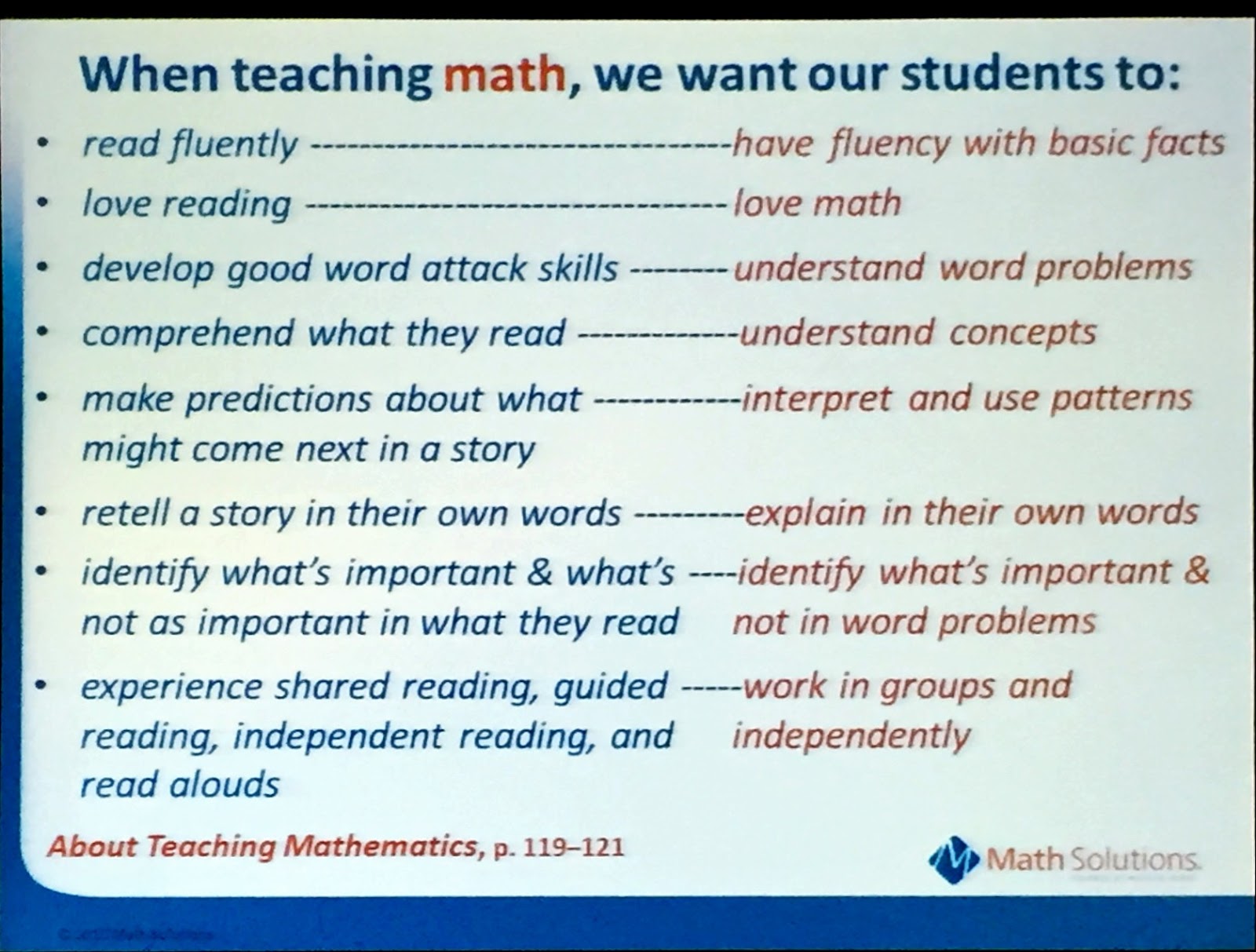
• Marilyn Burns (@mburnsmath)
Be purposeful about what we want our students to do. I loved this slide, connecting reading and math:

• Christopher Danielson (@Trianglemancsd):
Be purposeful with knowing the ability of students. Christopher said,
"Students can. We should let them."
This idea lends itself to students discovering properties in math. Often, when things get discovered in math, they are named after the discoverer. Why don't we do this more with students?"
Goods here.

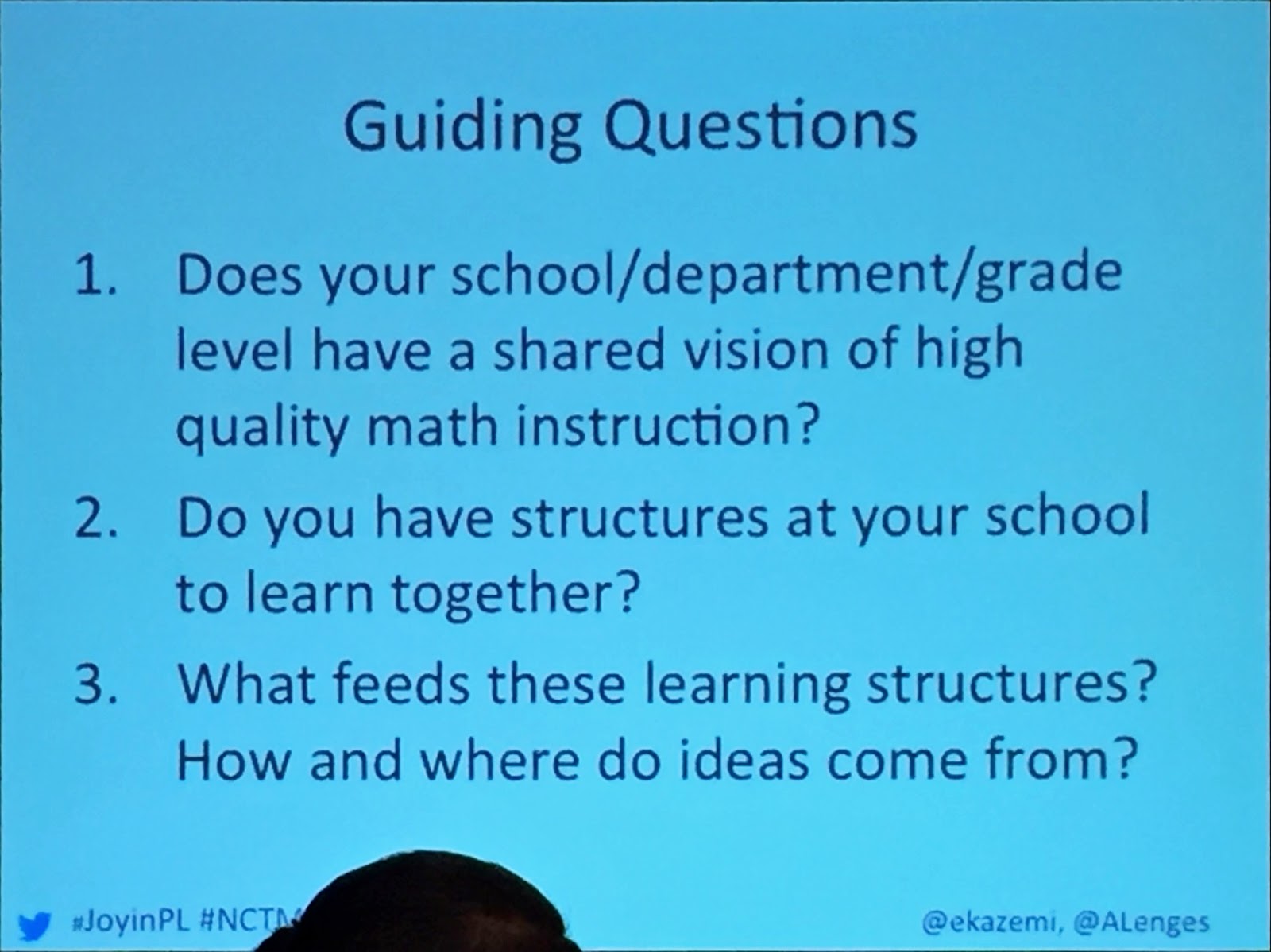
• Elham Kazemi (@ekazemi):
Be purposeful with a school/department/grade having a shared vision of quality math instruction. Create a structure at your school to learn together. We went on to explore numberless word problems where the purpose is to help students make better sense of the context before applying the numbers. She shared this post by Brian Bushart.

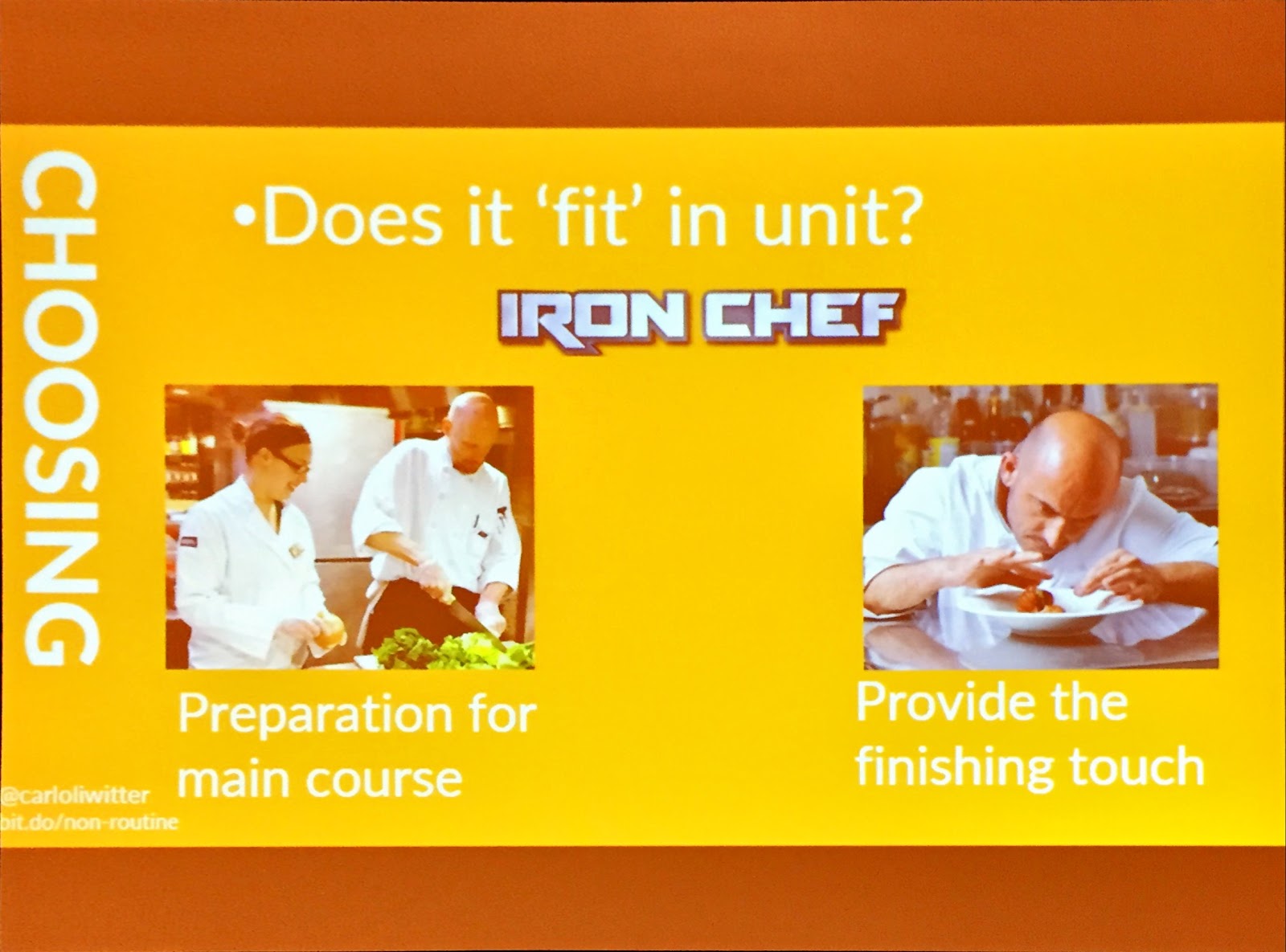
• Carl Oliver (@carloliwitter):
Be purposeful with the space you provide students to explore mathematical ideas. Be purposeful with selecting the task.
Goods here.

• IGNITE talks:
Max Ray (@maxmathforum):
Be purposeful with the resources, tasks, activities, and ideas you pull from the internet. Be purposeful with the coherency in your teaching. Do the resources, tasks, activities, and ideas you pull from the internet add to the coherency of the mathematics you teach?

Jennifer Wilson (@jwilson828):
Be purposeful with the time you allow students to solve math. It's not like fast food, it's like slow food. Enjoy the math students can do when we make it a purpose to do #slowmath.

• ShadowCon16
Kaneka Turner (@KanekaTurner)
Be purposeful in making math a social experience by inviting others into this awesome experience. Kaneka shared the importance of being invited. Call to action: invite at least one person to be part of the math experience.

Robert Kaplinsky (@robertkaplinsky):
The purpose of empowering others through influence can have huge positive results. Robert shared a couple of personal parts on his life and how influential people throughout his life have helped shape who he is today. Call to action: your your power to influence and empower others.

Graham Fletcher (@gfletchy):
Be purposeful in knowing what/how you teach by understanding the standards. Be a better story-teller in your classroom by accurately knowing the standards. Call to action: find out more about a standard you teach.

• Brian Shay (@MrBrianShay):
Be purposeful with polynomials and probability. Brian had us working on using spinners and coins to add meaning to multiplying polynomials.
Goods here.

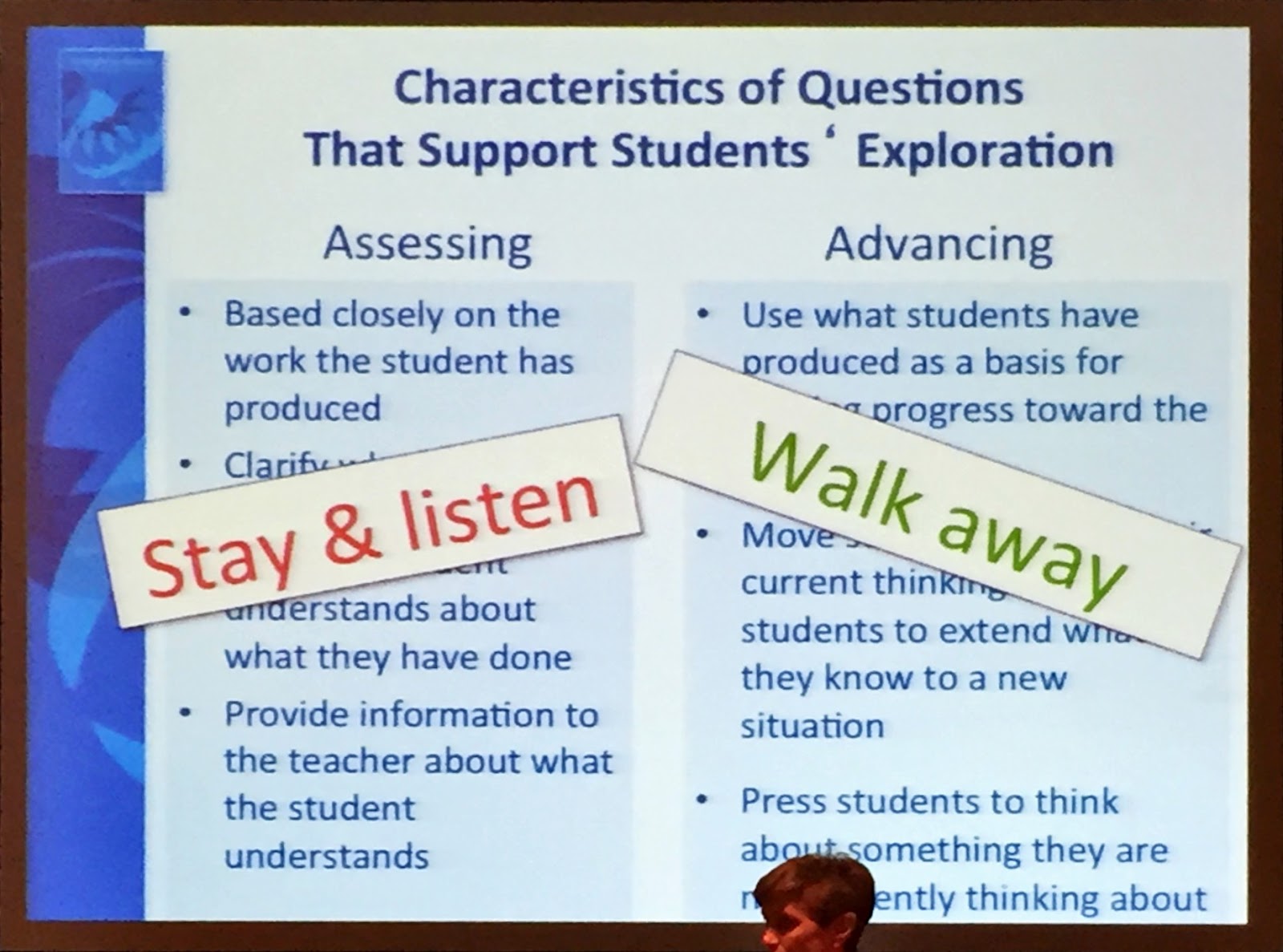
• Peg Smith:
Be purposeful in framing the task so it "invites everyone in." Furthermore, ask purposeful questions when working with students during problem-solving tasks. Lastly, it's critical for the teacher to explain the goals because it's hard to have a conversation if it's unclear what you're trying to accomplish.
***Let's invite Peg to the #MTBoS and Twitter.

• Andrew Stadel (@mr_stadel):
Be purposeful in the feedback we give students after they make mistakes. Thanks to Robert Berry and Dylan Wiliam, I shared with teachers the importance of providing feedback that benefits students and at the same time challenging them to take traditional feedback and rework it so it's better at moving the learning forward.

• Christina Tondevold (@BuildMathMinds):
Be purposeful in working toward the terminology in the standards, specifically "fluently" and "using strategies" in the K-5 standards. We looked at examples of subitizing, cardinality, and strategies like making ten, double-plus-one, finding fives. We need to be purposeful in students making sense of math for themselves.

• Jason Zimba
Be purposeful in decluttering what we teach, what we ask of students, and what we give to students. Something he got me thinking about: do we Math 8 teachers need to teach the "elimination" process when solving linear systems. Does the procedure support the conceptual understanding? and can we allow high school teachers to teach it while Math 8 teachers focus on graphing and substitution?

I hope to see you at NCTM 2017 in San Antonio.
Send in a speaker proposal here by May 1, 2016.

San Fransisco,
2016


Sunday, March 20, 2016

CUE 2016 Takeaways

This past weekend was CUE 2016 and I only attended one day of the three conference days. Even though it was just one day, I was able to leave with some great takeaways.

Session 1:
Making the Hard Parts Easy: Teaching in 2016 and Beyond
by Matt Vaudrey
Great session. Matt is always a treat to watch in a presentation, and he continues to deliver solid, engaging, practical, and useful sessions. He had us up talking with each other, moving around the room, learning from others in the session. He modeled music cues by giving us a 60 seconds to discuss focused questions with a partner (different every time). The music stopped and we knew to stop our conversation so that Matt could allow two teachers the opportunity to share out their conversation.

The session was focused. I love when a presenter tells the attendees in the beginning what we will be doing and sticks to it. We focused on:
  • Focus on what matters
  • Mess with Curriculum
  • Give students authority 
My biggest takeaways:
  • Look into Kaizena to offer students voice feedback inside Google docs. 
  • Assign less work to students... just one way to make grading easier.
  • Quicken transitions in class with music cues by Matt Vaudrey (found here).
  • Matt's slides can be found here.
Session 2:
Another great session. Both JR and Gerardo encouraged the attendees to focus on the "why" when preparing professional development for your site (teachers and admin). Essentially, define the purpose of your session because time is valuable for everyone. I also loved how they had us take a PD title we recently used and rewrite it so it includes the "why" (purpose). Great idea!

My biggest takeaways:
  • Use empathy with teachers and administrators
  • Value everyone's time!
  • Start with the "why".
  • Their goods can be found here.
Session 3:
It was an extreme pleasure to prepare and present with JR. I love his enthusiasm and excitement for science, good PD, and Desmos. The focus of our session was simple: play, tips, and build. We allowed attendees to play two Desmos activities (one from JR and one from Cathy Yenca). We showcased the teacher dashboard for each activity and then we shared our activities so the attendees could see how the activities were built in order to explore the building part of desmos activities. We reassured the attendees that they don't need to necessarily build their own activities, because they could find one in the Desmos library or the Desmos Bank and adapt it for their needs. Thanks to all the teachers who came to our session. We hope it was helpful and you will let us know how teacher.desmos.com is transforming your classroom.
Thanks JR. It was a blast to collaborate. I learned a lot.

Session 4:
I came in late to this session, but it didn't matter. It was easy to know where they were in their presentation.  Within minutes, we were working on the floor categorizing these cards with different colored shapes as a segue to the importance of the Periodic Table. It was a splendid activity. Both Dan and JR shared their experiences in their science classes. A big part of their class was using media to create mystery so students are asking questions. Similar to a 3 Act task. It was a wonderful way to end the conference.

My biggest takeaways:
  • Create mystery with students. Use stories to explain the mystery
  • Our brains, chemically, enjoy stories. Use them more often in class.
  • Their goods can be found here.
Thank you to all the presenters who worked so hard to prepare great sessions. By reflecting on the highlights, it will allow me to incorporate many of the techniques, resources, and ideas with the teachers I support and the professional development I offer.

CUE,
933

Bonus:
I loved this on display at the Hard Rock Hotel. Sorry, I didn't grab the artist behind this gem. Look close, those are vinyl records. So cool!


Monday, March 14, 2016

Classroom Clock Questions

I'm curious about the precious classroom time we [math] teachers have with students.
Enlighten me.

Please take 1 minute to fill out this form as I prepare for an upcoming Ignite talk at NCTM.

Thanks,
Andrew


Monday, February 29, 2016

Square Dance

I recently debriefed with a fellow (teacher I support) about two activities focusing on Squares, Square Roots, and Irrational numbers. Let's build number sense. Here are the goods:
She ran both activities with students, starting with the Clothesline activity. She used the cards linked above for students to first place the visual representations on the number line. It looked something like this:
Followed by:

Students then completed the first 7 screens in the Desmos Square Dance activity. Screen 6 includes a validator when done correctly, compliments of Nathan Kraft.

*Please note that part 1 of the activity uses only whole numbers as rational numbers. I highly recommend using the activity as a launching point for students to know that perfect squares include other rational numbers like fractions and decimals. 

Back to Clothesline:
This week she will use the next set of cards for irrational numbers. It might look something like this on the number line:
Followed by:

Back to Square Dance 
Students can build better conceptual understanding of irrational numbers in the desmos activity. Also look for teachable moments throughout the activity. 
*Please note screens 11 & 15 include non-repeating and non-terminating decimal notations. 
Screen 11

Screen 15
Just like Screen 6, Kraft-y validators are included on screens 12 & 16.

Two closing thoughts:
1) My fellow was so happy to use these conceptual representations with clothesline and desmos. 
2) She hasn't seen students making mistakes like she has in the past. Here's an example (crossed out) of a common mistake she has seen regularly in the past.

If you have time, head over to this post and have your students play War with the Rational-Irrational cards provided.

Dance,
945