Showing posts with label Michael Pershan. Show all posts

Sunday, March 8, 2015

A Jammed Rational-Irrational War, Stacking Cups Week

Some cool stuff happened this week. Well at least I think it was cool.

Monday
One of my math fellows was observed by other math teachers from our district. He was starting a new unit with rational and irrational numbers, focusing on 8.NS.1 and 2. I might be wrong, but pretty dry stuff… here’s how we spiced it up a little.

We did a pre-assessment using the Post-It Plus app. Yes, my obsession with Post-It notes has gone to a new level: digital. We created a file within the app, posted it on his Haiku calendar, and had the students download the file into their app on their iPad. 

Students first worked individually to sort the terms from least to greatest for a few minutes. Since his students are grouped in fours, they then narrowed it down to one iPad screen they thought was most accurate. (Quick demo)

*Reflection: we should have had students paired up first, discuss, and narrow it down to two screens for the entire group. Next, the whole group of four students would discuss and narrow the two iPad screens down to one screen for the group.

Once each group settled on a screen they felt most confident with, they took a screenshot and uploaded their group’s screenshot to the Padlet page my fellow created for them.

My fellow used this Padlet page to assess the overall climate of the class (without teaching them a single thing). He used this real-time data to have some really rich conversations and share-out of ideas from students.

Remember to tell students:
  • It’s okay if you’re wrong. 
  • Make your best guess.
  • I just want to see what you already might know.
Flash forward to Friday:
The previous weekend I asked the same fellow what he thought about playing War with rational and irrational terms. Side note: I play a few card games with my young son and one of them is War. My fellow thought the idea was epic. He ran with it. Here how he made it awesome:
  • He made these awesome cards.
    • Some values had multiple representations
  • Printed them out on card stock.
  • Made a graphic organizer for students.
  • Each group of four was broken down like this:
    • 2 people played War while the other 2 people recorded and were the judges.
    • The next round, the roles were switched.
  • There were 3 rounds.
  • Each round was 6-10 minutes
  • He stopped class and made a spectacle whenever two students were at war.
  • The third and final round was between the winners of the first two rounds.
I asked if I had his permission to share the cards and he said, “Sure.”

Tuesday:
Another fellow asked me to model Stacking Cups in their first period class, which ran less than 45 minutes. My fellow requested I complete the task with students in one period. I explained that I’ve never “finished” the task in one period because there is so much to explore and learn in the task. I respected the request and  tried to cram it into one period. I spent too much time launching the task. 

Act 2 (the best part) felt rushed and we still didn't finish. My fellow and I debriefed and made some adjustments so she could finish it with her next period. She stuck to the adjustments and did a fantastic job facilitating the task. The students were doing awesome and amazing math during Act 2… and what do you know? The class was over. I love that my fellow was going to revisit the task the next day. Could we have spent another day on the task? Yes. It’s a starting point and I’m very proud of my fellow for trying out something new and doing a great job. I’d say the sweet spot would be one-and-a-half days for this task...
*Side note: I encourage you do styrofoam cups earlier in the year, and use Stacking Cups throughout the entire linear systems unit.

Thursday:
Another teacher wanted me to model Stacking Cups as well. When we sat down to plan, she was totally cool with spending one-and-a-half days on the task. Great news!
I launched the task, used a Padlet page to capture what they noticed. I asked the question, "Where will they tie?" and used a Google form to collect their guesses (see my post on using Google forms to collect student thinking). 

We gave each group only 4 white styrofoam cups. Students were making tables, or writing equations, or some were even wanting to graph their equations. Interesting note: some students started their table with zero cups having a height of 9.2 centimeters. The teacher had only taught graphing systems, so students were already thinking ahead to substitution. It was awesome. She did a wonderful job facilitating her first 3-Act task. We didn’t finish the task in one period, but it felt right knowing we had another half-day to wrap up the task. 

Back to Friday:
After work, I started putting the meat in my upcoming session, Math Mistakes and Error Analysis: Diamonds in the Rough. Although I will be showcasing a couple ways I’ve had success with error analysis with students, I love that I’ll be showcasing some awesome work and contributions from:
Hope to see you in my upcoming session as we explore why error analysis is important to:
  • help drive instruction
  • curb student misconceptions and
  • strengthen formative assessment. 


Hope your week went well too. If not, hope this week is better.

Rational/Irrational,
516


Saturday, June 8, 2013

QOTW 2nd Semester - 2013

In January, my Quotes of the Week post highlighted student comments captured during our first semester of the 2012-2013 school year. I'm here to post a few captured from the second semester. It's hard to compare them to the first half of the year, so let's not. Instead, let's just enjoy the comments, observations, or questions that students gift us with, enriching the mathematical climate of the classroom.

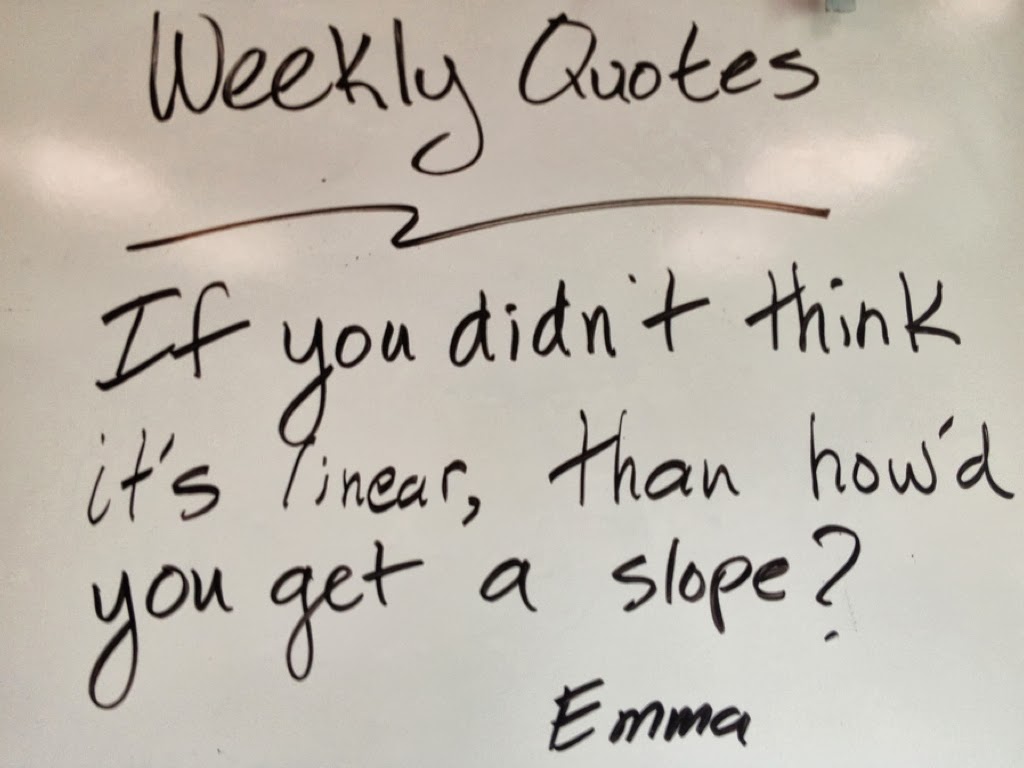
I experimented with Kelly O'Shea's Mistake Game in Algebra about midyear. Emma is presenting to the class about identifying linear functions, given three points. Justin (from the audience) claims that Emma’s graph is NOT linear, but says there's a slope to her three points. Without skipping a beat, Emma unleashed this response at Justin. Way to go Emma! Talking smack with math vocabulary.

Students were exploring x- and y-intercepts using Desmos.com. After graphing a few lines and writing down the ordered pairs of each intercept, the wheels started to turn inside of Lisa's head. She saw the structure and pattern of the intercepts containing zero. The follow-up:
Me: So Lisa, why are you seeing all these zeros?
Lisa: Because we're learning about intercepts today. 
Me: What are the intercepts of the lines? 
Lisa: It's where the lines hit the x or y axis. 
Me: So what's up with all the zeros? 
Lisa: If it hits the x-axis, the y value is zero. And if it hits the y-axis, the x value is zero. 
Me: Bingo! 
Mark needed to graph a straight line as part of his task. That week, we had just spent an entire class period doing a Jigsaw activity so that the students could explore the 8 Standards for Mathematical Practice. Mark is proud to be using Mathematical Practice 5, Use Appropriate Tools Strategically.

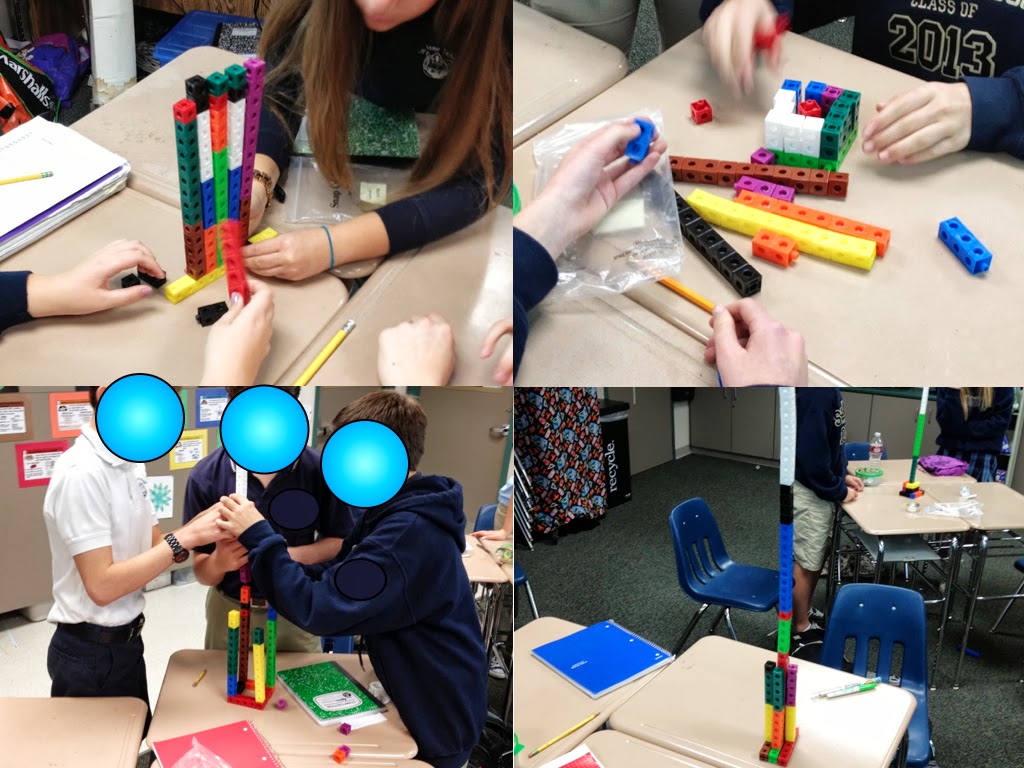
Groups were given a warm-up one day where they had to collaborate and stack the highest and strongest tower using 100 snap cubes. I determined the winners by kicking the desks they stood on to see who survived Earthquake Stadel the best. While cleaning up, Logan is noticing that he could do a better job next time. This is exactly what we can do in the math classroom: learn from our mistakes, come up with a revised problem-solving plan, model, collaborate, and persevere.

The class was doing a cocktail of mixture problems one day. They were collaborating with their groups and one group had your typical coin question. Something along the lines of:
I have $9.75 from X amount of nickels and dimes. How many of each coin do I have?

Upon solving the question on their whiteboard, Sara quickly realizes that you can’t have 1.95 of a coin. She was the first to notice it and say something to her classmates about this contradiction. The group first tried looking for their mistake and then tried solving the question again. Good job girls!

Midyear, I showed all my classes the 1st Semester QOTW slides. For the first month following these slides, Charles was trying to turn every little thing he said into a quote just so he could be up on the board. As I've mentioned before, these can't be planned or contrived. These quotes just come out naturally in the regular happenings of classroom interactions.  Students were doing some individual work one day, and Charles actually let a good one slip out. He was still working individually on the task and didn’t want his efforts spoiled by someone blurting out the correct answer. How many times have we been there, either on the receiving end or the one ruining it for others?  

This is Jenna's response to the following video:

I asked the class for their interpretation of the video or any of the drawings? Was there a drawing they could relate with? Without blinking, Jenna says, "It's like graphing stories." I totally agree. It had been awhile since we explored graphing stories, so Jenna just confirmed what a great impact that concept had on her. Very cool! 

Arielle is a former QOTW winner. Students were exploring exponent rules by finding mistakes. Michael Pershan and I have done some extensive blogging about this. Anyway, we had reached the final day or two of learning through mistakes and Arielle raised her hand and shared this gem with everyone. It's a beautiful observation in my opinion about the importance of math mistakes, learning by making conjectures, and students coming up with the rules on their own instead of me spoon-feeding them. 

Two quotes in one class period! That's a first. We were playing Race Car Math and one of the review questions asked students to factor a polynomial. Eli, a boy a few words, caught his group-mate incorrectly factoring the polynomial. I love the “Dude!” part of his quote.
Also during Race Car Math that day, Kailey was so excited to be on the board after correctly graphing a parabola, following the flowchart we put up in class. Our class flowchart is shown.

Last, but not least, Chris closed out the year with, "I think my number lied to me." In geometry, we were reviewing volume of a sphere with questions similar to Nathan Kraft’s volume of a soccer ball task. Chris set up, and used the incorrect proportion when solving. When arriving at an unreasonable answer, he realized his numbers lied to him. Way to check for reasonableness!

It's truly been a pleasure having the QOTW section carved out on my whiteboard for student quotes. As far as I'm concerned, this will be a staple in my classroom for the remainder of my career. I look forward to next year's quotes!

QOTW,
717

Saturday, June 1, 2013

CCSS Workshop 2013

I did my first workshop this past week (5-30-2013), discussing the transition to Common Core State Standards, with a focus on the 8 Standards for Mathematical Practice. I'm working with K-5 elementary teachers, a couple of middle school math teachers, some support teachers, and a couple of administrators in the room. I'll admit, I'm not as eloquent a speaker as Steve Leinwand, but there might be a few times where I actually make sense. I'm throwing this video out there for some feedback. I don't expect you to watch the whole thing so I've provided some chapter markers you might be interested in. At the end of the notes for each chapter, I reflect by creating a wish-list of moves I would've done differently. They come across as rhetorical questions, but feel free to chime in. However, here are a few angles I'd appreciate you considering:
What did I forget to talk about?
Where could I have been more explicitly clear?
Where coud I have used a better strategy? ...and so on.


Opener: 0:00-10:10
I use an estimation task (Day 127) to kick things off, providing teachers with the handout Michael Fenton created for estimation180.com and my students. The handout has been through many revisions and I think we have a final version that's a winner.

I use the whiteboard to write the "Too Low", "Too High", and "My Estimate" of a few teachers, asking for reasoning along the way. We watch the answer and discuss.
8:15 is a precious moment where a teacher asks, "Wait a minute! What was it (the song length answer) really?" I love how a teacher is demanding more information. I wish I spent more time expressing the importance of her question. I feel rushed because of all the workshop content I have prepared. I wish I had allowed the other teachers to address her question more. I do with my students, why didn't I do this here?

Active Notebook Part 1: 10:15-12:55
Teachers glue their Estimation 180 handout to the inside cover of their workshop Blue Book and the Table of Contents to the first sheet while listening to Can't Buy Me Love.

Preview of Workshop: 12:55-20:50
I attempt at working on the following question throughout the workshop,
What's our role as we reshape the classroom with the Common Core State Standards?
I share with teachers what today will not be and what today will be. On a parallel universe I share with teachers what I perceive the CCSS to not be and what I perceive the CCSS to be. Then I share a few personal items from this past school year. Seeing that I'm doing a workshop with multiple grade level and content teachers, I'm expressing the focus of the day to be the 8 Mathematical Practices and what we do in the classroom. How do we help facilitate the learning?

Estimation Task #2: 20:50-26:45
We use Day 129 where teachers see that the song length is also the track length. Listen to their reasoning. I love this! Hearing this reasoning from teachers and students is one of the many joys I get from doing these daily estimation tasks. However, I wish I did a better job (23:50) of getting the teachers to justify their reasoning and "argue" a little more than I did. I wish I created a little more tension. Check out (25:00) the excitement of the teachers as they watch the answer.

I introduce the language of creating a task that has a low-entry point and could see that many teachers had no idea what I was referring to. Not their fault. However, I like their reaction when I translate "lower-entry point" to being easier. I wish I explained "low-entry point" better. I wish I had explained it as creating a task where most, if not all students have an equal opportunity to engage with the task, regardless of their mathematical proficiency. I wish I expressed the importance of providing students with a task where math vocabulary and thinking come as a natural result of solving the task.

Math Tools & Two Uses: 26:45-33:55
I ask teachers to glue a picture of a math tool to the front of their Blue Book and write down at least two uses for each tool. They have two minutes to complete this task. After We Will Rock You, I ask the teachers for their uses instead of telling them. This serves two purposes. Yes, I have a list of uses that I anticipate them to come up with, but I want to hear from them first, selfishly providing me with additional uses that I didn't anticipate. Secondly, I'm using this activity to illustrate how students need to provide the answers in the classroom. I wish I could have given this more time in the workshop where the teachers actually used the tools in the manners they suggested. I also should have had the teachers write down all the uses we came up with.

Introduction of 8 Mathematical Practices 33:55-1:04:00
Again, I'm feeling rushed for time! Yes, I said it, "Let me talk about these 8 Math Practices real quick." Real quick? How silly of me. These practices are not something to gloss over. Don't worry, we spend ample time doing a Jigsaw activity so teachers are out finding information about them. I provided the teachers with the handouts found at Jordan School District's site. The practices are presented in a manner representative of the grade level you might teach. Thanks Fawn for this link.  I could have explained and facilitated this a lot better, but the redeeming value is hearing teachers that were appreciative of this specific activity because they were "forced" to explore the practices instead of just receiving a handout with the information embedded. If I were you, I'd skip the section (39:30-52:00) unless you want to hear some of the teachers talking in their groups as they rotate around the room to their four different stations. I'm proud of the rotation table I provided and how teachers travel together according to their "math tool." DON'T miss the "perfect high-five" at 38:10. I love that a teacher commented that "perfect" is subjective. I say this all the time to my students.
At 52:30 I give teachers time to regroup and complete the practices by receiving information from the other teachers in their group. I recap (1:00:00) and then show teachers how to create a pocket (1:01:00) inside their Blue Book so they can store a Quick Reference "teacher" version (I referred to as "adult") of the 8 Mathematical Practices.
I wish I gave more time for reflection. I wish I reviewed each practice with the whole group by having them share out loud something they learned. During the Jigsaw activity, I was told that my time with the teachers was cut short by about ten minutes so I had to hurry things along. Arghh!

Find My Mistake: 1:04:20-1:13:00
I made an executive decision to skip the model lesson I had prepared for the worksop. I'm glad I didn't skip the Find My Mistake segment of the workshop. I'm very adamant about teachers finding the mistake quietly here. I encourage them to share with each other before we review with the whole group. I give props to Michael Pershan for mathmistakes.org. You can hear kids in the hallway, alerting me that our workshop is coming to an end very soon. We listen to each other make corrections or talk about the misconception and why us teachers are good at knowing the content we teach. We're constantly telling students what their mistakes are and telling them how to fix it. Let's switch that role. Make the students find, correct, and tell each other what the mistakes are, especially items that use algorithms. Remember, most of the teachers here are elementary teachers. I also point out that I haven't been jumping for joy every time a teacher gets an answer correct. Instead, I try my best to throw it back on the class for what they think, allowing them to critique the reasoning of others. I love how estimation and number sense is addressed with teachers on how to help encourage students to avoid these mistakes.
I hit a nerve (1:10:45) when I was asked, "What about simplifying?"
I could very well be wrong here, but my current understanding is we (as teachers) are to allow for multiple representations of the correct answer, unless explicitly instructed otherwise. In other words, ten-eighths is just as acceptable as five-fourths.
I wish I reviewed with the teachers the importance of doing an activity like this quietly and individually first, before group discussion. I wish I expressed how much I love group work and collaboration, but need to remember both teachers and students need that quiet time FIRST. The worst is being in a group where one person dominates the conversation and you don't have time to think or worse, problem-solve. I wish I had covered this with the teachers.

Summary: 1:14:15-1:19:00
I provide teachers with a fill-in-the-blank handout to glue to the inside of the back cover. Again, watch their reaction when we get to "low-entry" point. I hope I drive it home when referencing the "Cent-ed Whiffle Ball" task I recently did in Geometry. I remind myself and the teachers to listen to the students. I'm constantly working on allowing students to finish their thoughts. Don't cut students off or finish their sentences for them. I ask teachers to create a couple of goals. I provide the teachers with a list of resources found here. I like how they (at least some of them) want another in-service/workshop.
I wish I emphasized the importance of knowing the 8 Mathematical Practices better and to use the summer to better prepare for next year. I wish I had more time to pump up these points in the summary. I wish I had more time!

Unleash yourself in the comments if you will.

Thanks!
729