I'd love some feedback on this tool I'm tinkering around with right now.
I was inspired by Graham Fletcher, seeing him place student estimates inside ranges, or bins if you will. My goal was to make a tool that replicated this experience, is efficient for teachers to use, and added some visual enhancements. The tool could be used with Estimation 180 challenges and was made in Desmos.
What successes might you see happening in your classroom when using this tool?
What challenges might you see happening in your classroom when using this tool?
What advice do you have for improving it?
Thanks in advance for your responses.
Bins,
303
Showing posts with label Graham Fletcher. Show all posts
Showing posts with label Graham Fletcher. Show all posts
Wednesday, June 28, 2017

Monday, April 18, 2016
2016 #NCTMannual reflection: Purpose
There is a lot to process from NCTM 2016. Being a contributor for the Global Math Department this week, I decided to feature snippets on the blog here in order to kill two birds with one stone.
I found it useful to connect all the NCTM goodness with a theme: PURPOSE.
• Marilyn Burns (@mburnsmath)
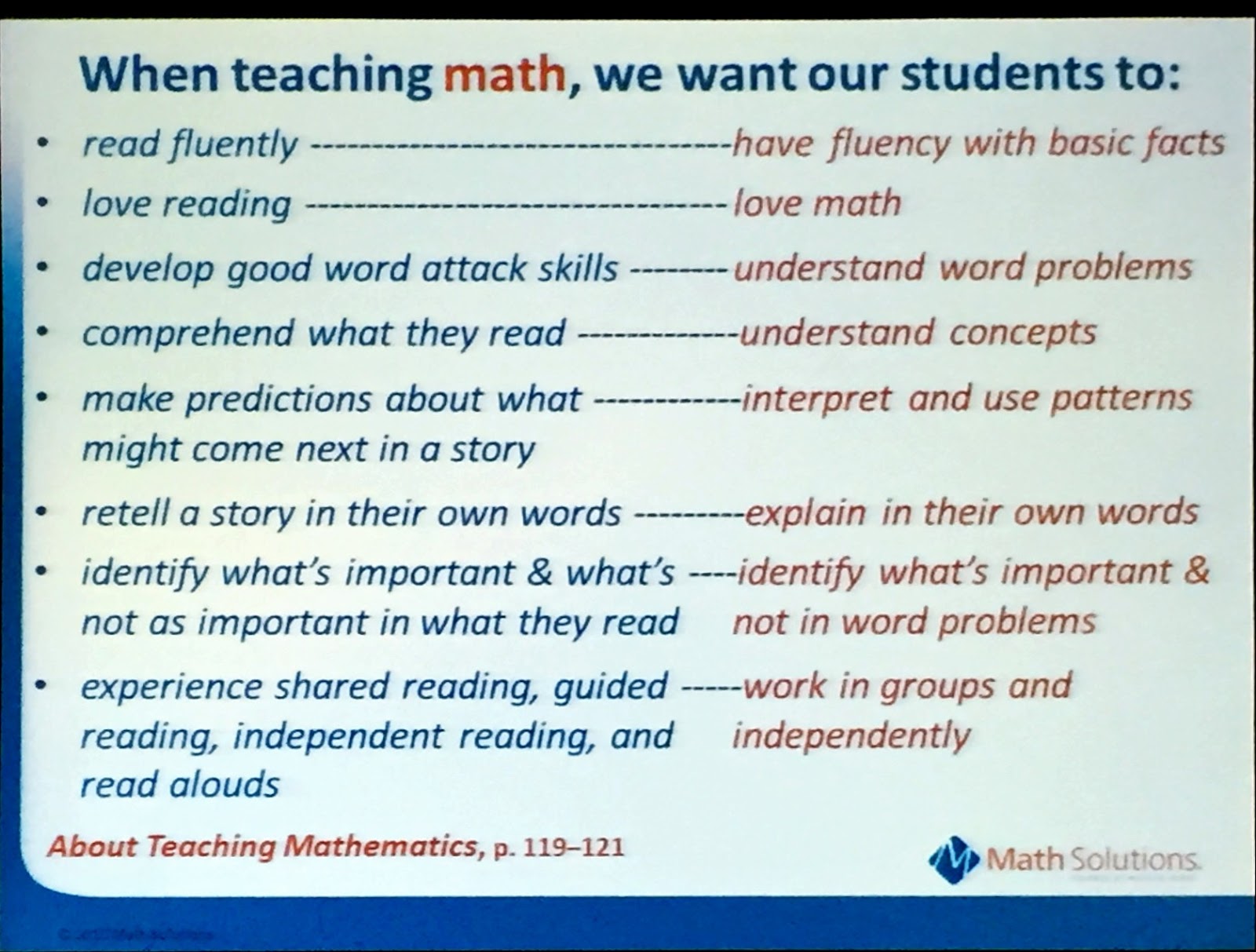
Be purposeful about what we want our students to do. I loved this slide, connecting reading and math:
• Christopher Danielson (@Trianglemancsd):
Be purposeful with knowing the ability of students. Christopher said,
"Students can. We should let them."
This idea lends itself to students discovering properties in math. Often, when things get discovered in math, they are named after the discoverer. Why don't we do this more with students?"
Goods here.
• Elham Kazemi (@ekazemi):
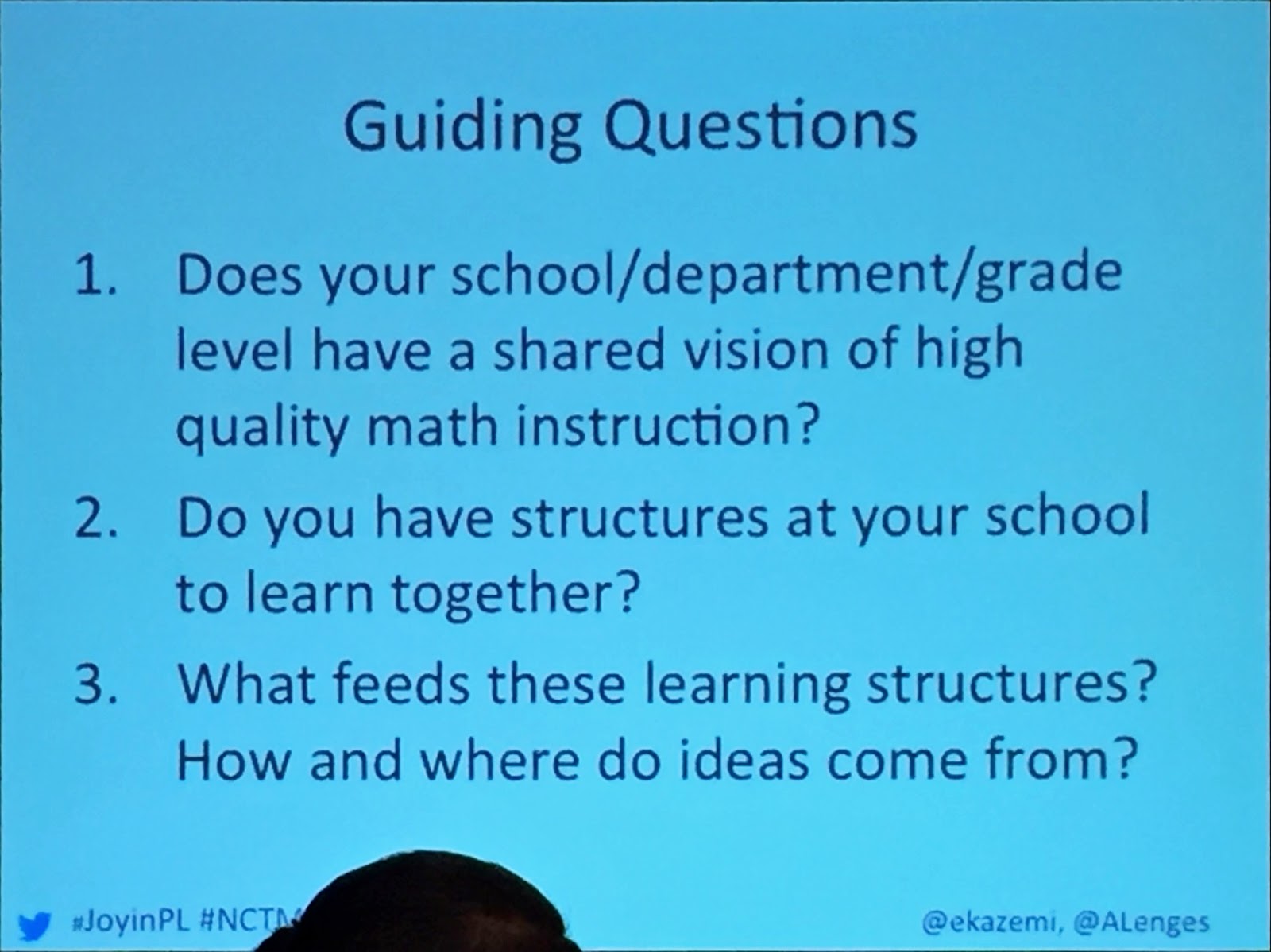
Be purposeful with a school/department/grade having a shared vision of quality math instruction. Create a structure at your school to learn together. We went on to explore numberless word problems where the purpose is to help students make better sense of the context before applying the numbers. She shared this post by Brian Bushart.
• Carl Oliver (@carloliwitter):
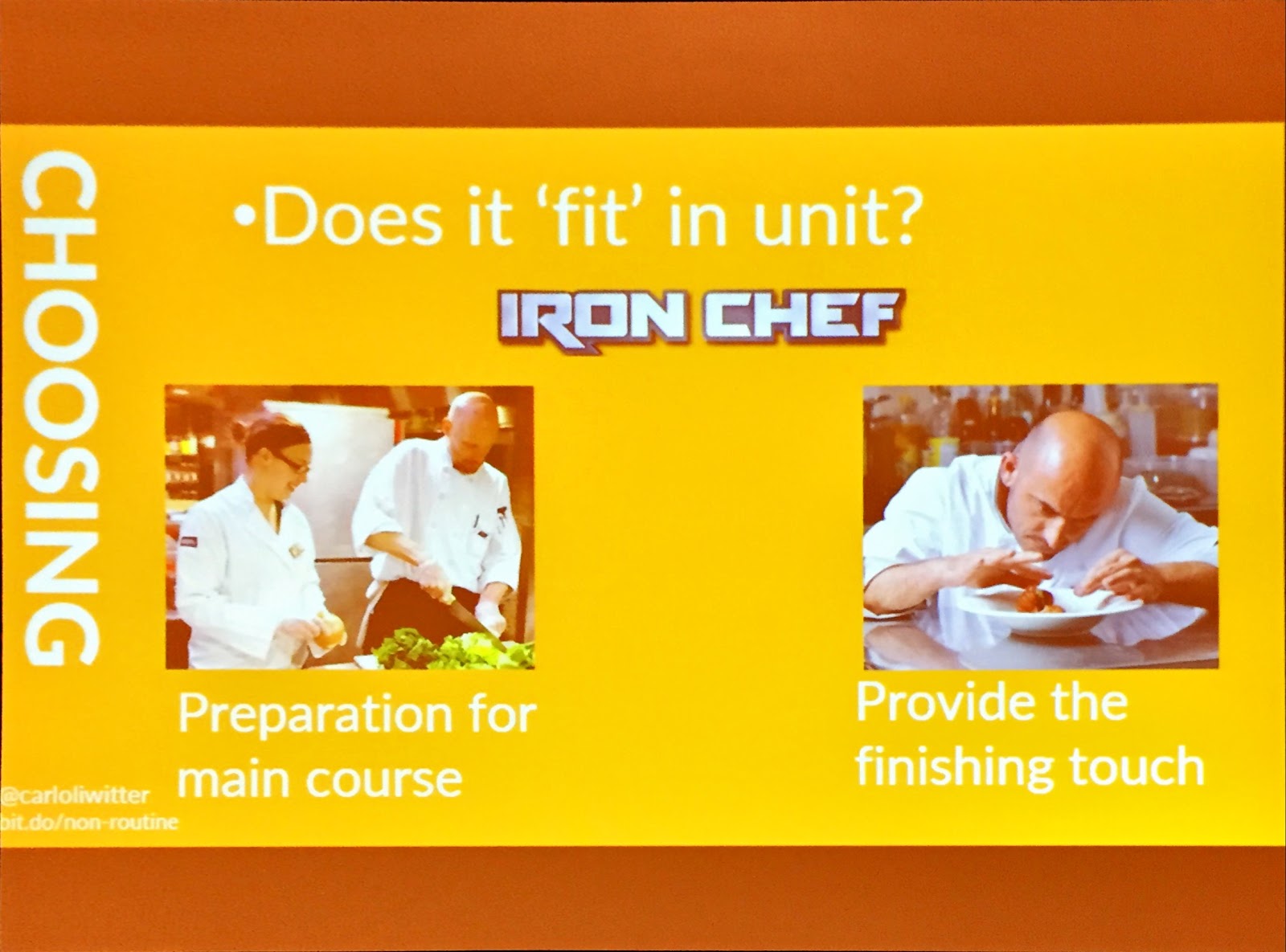
Be purposeful with the space you provide students to explore mathematical ideas. Be purposeful with selecting the task.
Goods here.
• IGNITE talks:
Max Ray (@maxmathforum):
Be purposeful with the resources, tasks, activities, and ideas you pull from the internet. Be purposeful with the coherency in your teaching. Do the resources, tasks, activities, and ideas you pull from the internet add to the coherency of the mathematics you teach?
Jennifer Wilson (@jwilson828):
Be purposeful with the time you allow students to solve math. It's not like fast food, it's like slow food. Enjoy the math students can do when we make it a purpose to do #slowmath.
• ShadowCon16
Kaneka Turner (@KanekaTurner)
Be purposeful in making math a social experience by inviting others into this awesome experience. Kaneka shared the importance of being invited. Call to action: invite at least one person to be part of the math experience.
Robert Kaplinsky (@robertkaplinsky):
The purpose of empowering others through influence can have huge positive results. Robert shared a couple of personal parts on his life and how influential people throughout his life have helped shape who he is today. Call to action: your your power to influence and empower others.
Graham Fletcher (@gfletchy):
Be purposeful in knowing what/how you teach by understanding the standards. Be a better story-teller in your classroom by accurately knowing the standards. Call to action: find out more about a standard you teach.
• Brian Shay (@MrBrianShay):
Be purposeful with polynomials and probability. Brian had us working on using spinners and coins to add meaning to multiplying polynomials.
Goods here.
• Peg Smith:
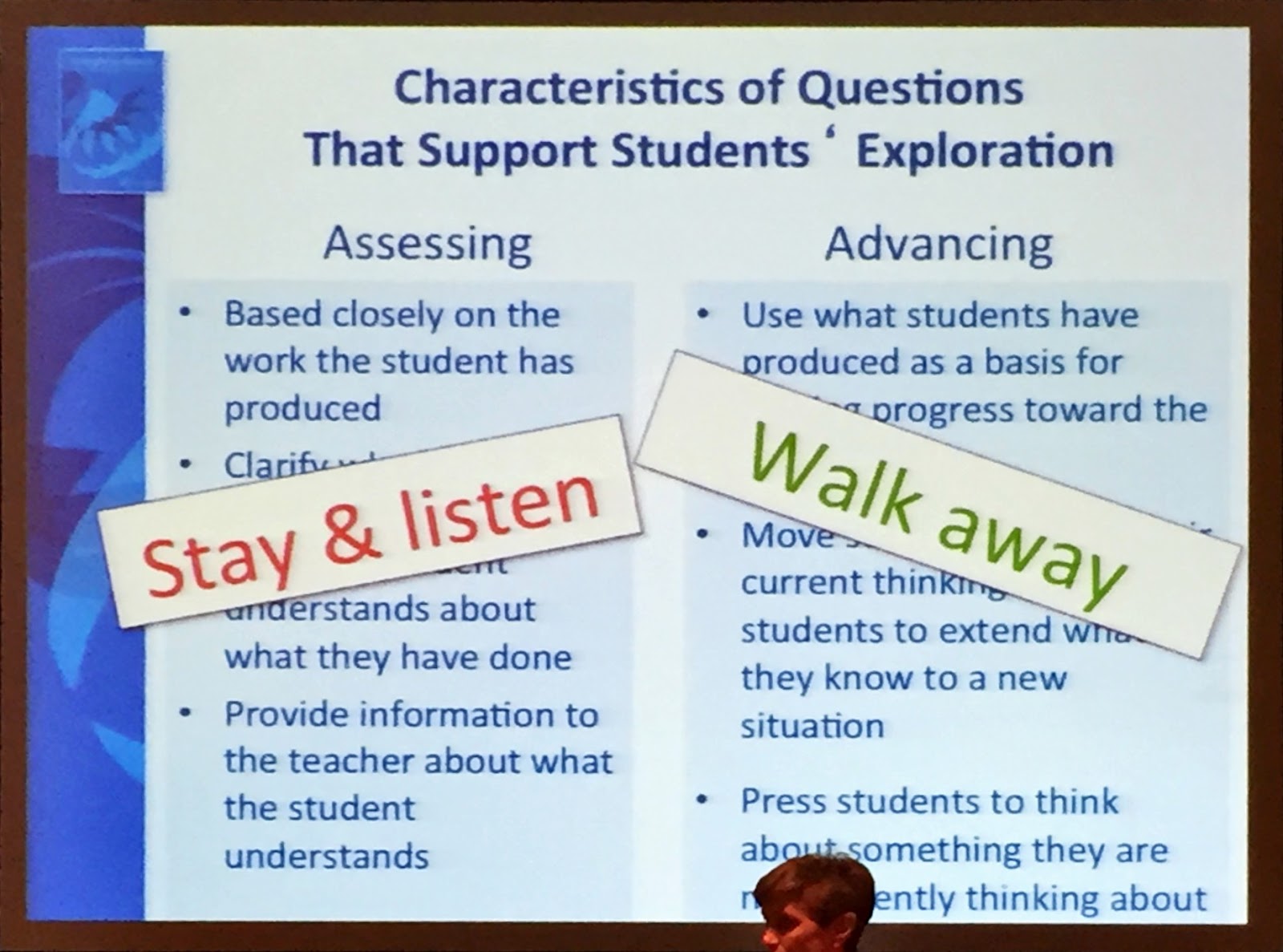
Be purposeful in framing the task so it "invites everyone in." Furthermore, ask purposeful questions when working with students during problem-solving tasks. Lastly, it's critical for the teacher to explain the goals because it's hard to have a conversation if it's unclear what you're trying to accomplish.
***Let's invite Peg to the #MTBoS and Twitter.
• Andrew Stadel (@mr_stadel):
Be purposeful in the feedback we give students after they make mistakes. Thanks to Robert Berry and Dylan Wiliam, I shared with teachers the importance of providing feedback that benefits students and at the same time challenging them to take traditional feedback and rework it so it's better at moving the learning forward.
• Christina Tondevold (@BuildMathMinds):
Be purposeful in working toward the terminology in the standards, specifically "fluently" and "using strategies" in the K-5 standards. We looked at examples of subitizing, cardinality, and strategies like making ten, double-plus-one, finding fives. We need to be purposeful in students making sense of math for themselves.
• Jason Zimba
Be purposeful in decluttering what we teach, what we ask of students, and what we give to students. Something he got me thinking about: do we Math 8 teachers need to teach the "elimination" process when solving linear systems. Does the procedure support the conceptual understanding? and can we allow high school teachers to teach it while Math 8 teachers focus on graphing and substitution?
I hope to see you at NCTM 2017 in San Antonio.
Send in a speaker proposal here by May 1, 2016.
San Fransisco,
2016
I found it useful to connect all the NCTM goodness with a theme: PURPOSE.
• Marilyn Burns (@mburnsmath)
Be purposeful about what we want our students to do. I loved this slide, connecting reading and math:
• Christopher Danielson (@Trianglemancsd):
Be purposeful with knowing the ability of students. Christopher said,
"Students can. We should let them."
This idea lends itself to students discovering properties in math. Often, when things get discovered in math, they are named after the discoverer. Why don't we do this more with students?"
Goods here.
• Elham Kazemi (@ekazemi):
Be purposeful with a school/department/grade having a shared vision of quality math instruction. Create a structure at your school to learn together. We went on to explore numberless word problems where the purpose is to help students make better sense of the context before applying the numbers. She shared this post by Brian Bushart.
• Carl Oliver (@carloliwitter):
Be purposeful with the space you provide students to explore mathematical ideas. Be purposeful with selecting the task.
Goods here.
• IGNITE talks:
Max Ray (@maxmathforum):
Be purposeful with the resources, tasks, activities, and ideas you pull from the internet. Be purposeful with the coherency in your teaching. Do the resources, tasks, activities, and ideas you pull from the internet add to the coherency of the mathematics you teach?
Jennifer Wilson (@jwilson828):
Be purposeful with the time you allow students to solve math. It's not like fast food, it's like slow food. Enjoy the math students can do when we make it a purpose to do #slowmath.
• ShadowCon16
Kaneka Turner (@KanekaTurner)
Be purposeful in making math a social experience by inviting others into this awesome experience. Kaneka shared the importance of being invited. Call to action: invite at least one person to be part of the math experience.
Robert Kaplinsky (@robertkaplinsky):
The purpose of empowering others through influence can have huge positive results. Robert shared a couple of personal parts on his life and how influential people throughout his life have helped shape who he is today. Call to action: your your power to influence and empower others.
Graham Fletcher (@gfletchy):
Be purposeful in knowing what/how you teach by understanding the standards. Be a better story-teller in your classroom by accurately knowing the standards. Call to action: find out more about a standard you teach.
• Brian Shay (@MrBrianShay):
Be purposeful with polynomials and probability. Brian had us working on using spinners and coins to add meaning to multiplying polynomials.
Goods here.
• Peg Smith:
Be purposeful in framing the task so it "invites everyone in." Furthermore, ask purposeful questions when working with students during problem-solving tasks. Lastly, it's critical for the teacher to explain the goals because it's hard to have a conversation if it's unclear what you're trying to accomplish.
***Let's invite Peg to the #MTBoS and Twitter.
• Andrew Stadel (@mr_stadel):
Be purposeful in the feedback we give students after they make mistakes. Thanks to Robert Berry and Dylan Wiliam, I shared with teachers the importance of providing feedback that benefits students and at the same time challenging them to take traditional feedback and rework it so it's better at moving the learning forward.
• Christina Tondevold (@BuildMathMinds):
Be purposeful in working toward the terminology in the standards, specifically "fluently" and "using strategies" in the K-5 standards. We looked at examples of subitizing, cardinality, and strategies like making ten, double-plus-one, finding fives. We need to be purposeful in students making sense of math for themselves.
• Jason Zimba
Be purposeful in decluttering what we teach, what we ask of students, and what we give to students. Something he got me thinking about: do we Math 8 teachers need to teach the "elimination" process when solving linear systems. Does the procedure support the conceptual understanding? and can we allow high school teachers to teach it while Math 8 teachers focus on graphing and substitution?
I hope to see you at NCTM 2017 in San Antonio.
Send in a speaker proposal here by May 1, 2016.
San Fransisco,
2016
Monday, November 23, 2015
Should 3 Act Tasks Build Literacy?
I went to the Nashville NCTM Regional session by Graham Fletcher and Mike Wiernicki and they showed this slice of awesome:

You'll notice they covered up the text of a [K-5] word problem only to show the question at the bottom of the chart paper. I thought this was a really slick move to get students talking, thinking, and imagining. If you've been to one of my problem-solving sessions lately, you'll know I'm really encouraging math teachers to push student potential by creating a mystery, layering in the clues, and solving the mystery. Therefore, the slide Mike and Graham displayed really resonated with me. Imagine students taking those stickies off one at a time, creating suspense in the process. More importantly, in my opinion, a teacher can scaffold in the context and literacy demand of the word problem.
Imagine reading one sentence (or one part of a sentence) at a time on that chart paper, as a class or with a classmate, working on understanding the context better and better with each sticky that is removed. However, the resonation of their slide didn't stop there with me. It really got me asking myself, "Can we help students simultaneously build math skills and literacy skills with 3 Act tasks?"
As much as I love how 3 Act tasks make the math accessible to more students because the literacy demand is usually removed, I agree with teachers that voice their concern about this actual feature. Understandably, they're concerned about the literacy demand that many of our state tests demand. (*concern should not be limited to state tests)
Essentially, I'm wondering if there's a natural way to work in the literacy demand during Act 1 and Act 2 of a 3 Act task? For example, let's use my File Cabinet task as an example:
Students watch Act 1:
After we gather student thinking (noticing and wondering a la Math Forum) and have students make a guess, I'm feeling the notion to present students with the textual representation of this task at some point. I'm not sure when that point is, since I badly want to test this out with students. The text might look something like this:
Moving into Act 2:
I think it's still important to have students think of information (identify variables) that is important to know in solving this question. Lately, I've been encouraging teachers to have students formulate a plan without any data, numbers, measurements, or other information. Lately, I've been seeing students just grab the numbers from Act 2 and hastily plow into a wrong plan or formula, getting unreasonable answers. My suggestion: Let's sit tight on revealing the information in Act 2. Get students to formulate a plan or representation first. Maybe make a more precise estimate in the process. After going through that process, maybe we can refine our original text description to something like this that now includes the measurements necessary in solving the task:


Similar to Act 1, I question if this would benefit both the math and literacy?
Since I am putting Act 1 and Act 2 under some scrutiny, it would only be fair to address Act 3 as well. Maybe the literacy in Act 3 seems more intuitive (all relative), but would this be a good time for students to write something that represents their plan from Act 2? For example:
I still believe in 3 Act tasks, don't get me wrong. However, I believe we might be able to get even more out of them as teachers. I consider this: at what point do we say to our students,
Many online colleagues gave input on building literacy into an Act 4. You can read more in the thread here. I support extended opportunities for more literacy like our colleagues suggest (or practice). However, my focus is during Act 1 and Act 2 right now. Help me think this through. Add some thoughts in the comments.
Literacy,
1020

You'll notice they covered up the text of a [K-5] word problem only to show the question at the bottom of the chart paper. I thought this was a really slick move to get students talking, thinking, and imagining. If you've been to one of my problem-solving sessions lately, you'll know I'm really encouraging math teachers to push student potential by creating a mystery, layering in the clues, and solving the mystery. Therefore, the slide Mike and Graham displayed really resonated with me. Imagine students taking those stickies off one at a time, creating suspense in the process. More importantly, in my opinion, a teacher can scaffold in the context and literacy demand of the word problem.
Imagine reading one sentence (or one part of a sentence) at a time on that chart paper, as a class or with a classmate, working on understanding the context better and better with each sticky that is removed. However, the resonation of their slide didn't stop there with me. It really got me asking myself, "Can we help students simultaneously build math skills and literacy skills with 3 Act tasks?"
As much as I love how 3 Act tasks make the math accessible to more students because the literacy demand is usually removed, I agree with teachers that voice their concern about this actual feature. Understandably, they're concerned about the literacy demand that many of our state tests demand. (*concern should not be limited to state tests)
Essentially, I'm wondering if there's a natural way to work in the literacy demand during Act 1 and Act 2 of a 3 Act task? For example, let's use my File Cabinet task as an example:
Students watch Act 1:
Mr. Stadel is using sticky notes to completely cover a file cabinet in his classroom. How many sticky notes will he need to cover the five visible sides of the file cabinet?Whether we (the teachers) present the text to students or students help compose the text description above, would this benefit both the math and literacy? Would it detract from the math?
Moving into Act 2:
I think it's still important to have students think of information (identify variables) that is important to know in solving this question. Lately, I've been encouraging teachers to have students formulate a plan without any data, numbers, measurements, or other information. Lately, I've been seeing students just grab the numbers from Act 2 and hastily plow into a wrong plan or formula, getting unreasonable answers. My suggestion: Let's sit tight on revealing the information in Act 2. Get students to formulate a plan or representation first. Maybe make a more precise estimate in the process. After going through that process, maybe we can refine our original text description to something like this that now includes the measurements necessary in solving the task:
Mr. Stadel is using 3" x 3" sticky notes to completely cover a file cabinet in his classroom. The file cabinet is a rectangular prism with a 36-inch width, 72-inch height, and an 18-inch depth. How many sticky notes will he need to cover the five visible sides of the file cabinet?Now that we know more information in this task, I think the original text should be adjusted (updated) accordingly. To me this feels like we have removed all the stickies from the chart paper Mike and Graham gave us.
Similar to Act 1, I question if this would benefit both the math and literacy?
Since I am putting Act 1 and Act 2 under some scrutiny, it would only be fair to address Act 3 as well. Maybe the literacy in Act 3 seems more intuitive (all relative), but would this be a good time for students to write something that represents their plan from Act 2? For example:
We found the surface area of each side by... We figured that we could divide each side by 9 square inches, the area of one sticky. In doing so we predict Mr. Stadel will need X number of stickies to cover the file cabinet.There are two big reasons I was initially drawn to these tasks. 3 Act tasks typically:
- eliminate the literacy demand, making the math accessible to more students.
- have Act 3 to validate (or break) the mathematical model we used in Act 2.
I still believe in 3 Act tasks, don't get me wrong. However, I believe we might be able to get even more out of them as teachers. I consider this: at what point do we say to our students,
Look, I first want you to access the mathematics without your english language skills (or lack thereof) getting in the way. We have to keep in mind that our state tests (and other math problems) require strong literacy skills. I think you need to see what this task might look like as just plain text.Or do we say this at all to students? parents? colleagues? administrators?
Many online colleagues gave input on building literacy into an Act 4. You can read more in the thread here. I support extended opportunities for more literacy like our colleagues suggest (or practice). However, my focus is during Act 1 and Act 2 right now. Help me think this through. Add some thoughts in the comments.
Literacy,
1020
Sunday, May 3, 2015
The Ultimate Task for Vertical Planning: Stacking Cups
This past week, I submitted a speaker proposal for NCTM 2016 in San Fransisco. The proposal is for a Grade 6-8 Burst (30 minutes) with the exact same title as this blog post: The Ultimate Task for Vertical Planning: Stacking Cups. I figure if I don't get accepted, at least I can share my thoughts here and you all can help spread the word about my idea if you think it has potential. If it does get accepted, I look forward to giving an update a year from now at NCTM. Here's my session description:
YES, YOU CAN! Instead, let's ask different questions like, "How can we use the same task to extend the mathematics each year?" and "How can we make connections to prior learning from the previous grade level?"
Let's work smarter, not harder.
I will spend the rest of this blog post highlighting each grade level and suggested uses for Stacking Cups. It won't be complete or the final version as this is through the lens of one person. I'm confident, with your help and critique, we can make it even better.
 Math 6
Question: How many cups do we need to stack (alternating) to reach someone's height?
We talk about rate. We organize our information on a number line, in a table, using a tape diagram, etc. We explore the rates using various models.


Math 7
Question 1: How many cups do we need to stack (alternating) to reach someone's height?
We continue the conversation started in Math 6 revolving around rates, using constant of proportionality. All of this can be represented in a table, as an equation, and in a coordinate plane.


Question 2: How many cups do we need to stack (consecutively) to reach someone's height?
We now shift our thinking a bit where there is still a constant increase with each cup, but there is an initial amount (the cup handle). Students explore how to write an equation to represent this situation and solve it.


Question 3: What would be possible dimensions of a box that would contain the cups to stack to someone's height? Which dimensions would be the most cost effective?
Imagine students understanding surface area and volume and how they're related to each other, especially if we model with mathematics, by identifying variables such as:


Math 8
Question 1: How many cups do we need to stack (consecutively) to reach someone's height?
Similar to question 2 in Math 7. However, we extend the mathematical understanding as we explore constant rate of change (slope), input and output, linear, and how our situation can be represented in the form y = mx + b.

Question 2: When will two stacks of different sized cups be equal in height and have the same number of cups in each stack?
We introduce students to linear systems using this task. Students can organize the information about each cup in a table. We can extend prior knowledge to represent the situation using graphs, equations, and functions.

 *By the end of Math 8, it might be helpful to mention (at least informally) to students the significance of discrete functions.
Algebra
We tighten up the math (both questions) previously learned in Math 8. How can we extend the mathematics. Add more challenging situations like the stacks start on different objects like desks, boxes, etc.
Question 3: How many cups would we need to stack in a triangular formation to someone's height?
This questions really extends the mathematics for students, but we can still use the tools they've learned from previous grades. Maybe students start by organizing the data in a table. Maybe they graph the data and notice it isn't linear. Maybe we can use desmos with sliders or a line of regression to explore quadratics.


Beyond Algebra and Geometry:
I'll admit this is where I'm a little rusty and would need you high school pros to jump in and contribute. I think with the triangle stacking, it can be taken from quadratic to a divergent series. I've also seen high school teachers come up with the following representations:


Al Overwijk also stacked cups in a triangular pyramid which is awesome.

Let's keep this vertical planning going. If you would like a couple charges, here you go:
432
Who says you can't use the same task each year? Come see why Stacking Cups might be the single best secondary math task to get teachers at your school, district, or state to see the importance and necessity of vertical planning. Use tasks that utilize connections from the previous year and extend the mathematics each year. Work smarter, not harder.Let's first back up a bit. I attended Alex Overwijk's session at NCTM Boston a few weeks back. I had already read his awesome blog post "Open Strategy Cup Stacking" and knew there are multiple teaching moments with Stacking Cups. I remember teaching Math 8 a few years ago and getting a lot of use out of Stacking Cups as you can see a couple times here and here. I was preparing for a training with math teachers from grades 6-12 and THAT's when it hit me: I could have a room full of math teachers from grades six through twelve and they all could:
- be working on this task
- see the different skills and tools necessary for solving
- know the expectation of each grade level
I've heard comments from teachers numerous times like,
"Well, if they do File Cabinet in 6th grade, I can't do it in 7th grade with my students."
"If they've done Stacking Cups in Math 8, then I can't do it in Algebra."
"If the 5th grade teachers use Estimation 180 with students, then I can't."YES! YOU CAN! It's called vertical planning.
YES, YOU CAN! Instead, let's ask different questions like, "How can we use the same task to extend the mathematics each year?" and "How can we make connections to prior learning from the previous grade level?"
Let's work smarter, not harder.
I will spend the rest of this blog post highlighting each grade level and suggested uses for Stacking Cups. It won't be complete or the final version as this is through the lens of one person. I'm confident, with your help and critique, we can make it even better.
Question: How many cups do we need to stack (alternating) to reach someone's height?
We talk about rate. We organize our information on a number line, in a table, using a tape diagram, etc. We explore the rates using various models.
Math 7
Question 1: How many cups do we need to stack (alternating) to reach someone's height?
We continue the conversation started in Math 6 revolving around rates, using constant of proportionality. All of this can be represented in a table, as an equation, and in a coordinate plane.
Question 2: How many cups do we need to stack (consecutively) to reach someone's height?
We now shift our thinking a bit where there is still a constant increase with each cup, but there is an initial amount (the cup handle). Students explore how to write an equation to represent this situation and solve it.
Imagine students understanding surface area and volume and how they're related to each other, especially if we model with mathematics, by identifying variables such as:
- cardboard cost
- delivery truck capacity
- store storage sizes
- consumer trends with buying cups
- more
Math 8
Question 1: How many cups do we need to stack (consecutively) to reach someone's height?
Similar to question 2 in Math 7. However, we extend the mathematical understanding as we explore constant rate of change (slope), input and output, linear, and how our situation can be represented in the form y = mx + b.
Question 2: When will two stacks of different sized cups be equal in height and have the same number of cups in each stack?
We introduce students to linear systems using this task. Students can organize the information about each cup in a table. We can extend prior knowledge to represent the situation using graphs, equations, and functions.
Algebra
We tighten up the math (both questions) previously learned in Math 8. How can we extend the mathematics. Add more challenging situations like the stacks start on different objects like desks, boxes, etc.
Question 3: How many cups would we need to stack in a triangular formation to someone's height?
This questions really extends the mathematics for students, but we can still use the tools they've learned from previous grades. Maybe students start by organizing the data in a table. Maybe they graph the data and notice it isn't linear. Maybe we can use desmos with sliders or a line of regression to explore quadratics.
Beyond Algebra and Geometry:
I'll admit this is where I'm a little rusty and would need you high school pros to jump in and contribute. I think with the triangle stacking, it can be taken from quadratic to a divergent series. I've also seen high school teachers come up with the following representations:
Al Overwijk also stacked cups in a triangular pyramid which is awesome.
Let's keep this vertical planning going. If you would like a couple charges, here you go:
Go to your site and/or district and push for Stacking Cups to be a signature task at all sites and secondary grade levels. Help support your colleagues with vertical planning. Report back.
Look for other tasks out there like Robert Kaplinsky's Hot Dogs or Dan Meyer's Penny Circle or Mathalicious' Wheel of Fortune or Graham Fletcher's Water Boy that can be used with vertical planning. Report back.Vertical,
432
Subscribe to:
Posts (Atom)