First, I avoided the Pythagorean Theorem (for now). On Monday, my students already knew we would be starting Barbie Zip Line on Thursday. That was about as much information as I revealed. Everything else was structured to elicit as much student insight, information, and ideas as possible.
I started by projecting this slide:


Me: Has anyone her gone zip lining before.A few hands go up.
Me: How would you describe it to someone in the class who has never been?
Katherine: Awesome!
Me: How would you describe what zip lining is to someone unfamiliar to it?
Katherine: You wear this harness. You ride down a line...
Mateo: You have two cables attached to you in case one of them breaks, there's a backup. Someone pushes you at the beginning and you ride along a cable...
Me: Great. Thanks. Would it help if we saw pictures or video of someone zip lining to give everyone a better perspective?
Everyone: YES!
Me: Here's what Google Images has for "zip line pictures".
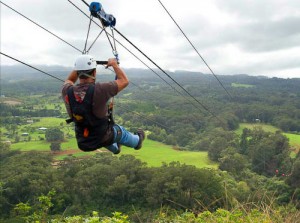
Me: A good business model will provide their customers with a safe and thrilling experience. Therefore, I'd like you all to fill out this Google Form with the following prompts and questions:
- Briefly describe the characteristics of a DEATH zip line.
- Briefly describe the characteristics of a BORING zip line.
- Briefly describe the characteristics of a JUST RIGHT zip line.
- What information would be useful to know when building a zip line?
- If we had a small scale zip line in class, what data can we collect from the small scale?


 |
| The actual zip line quad. |
Students go to this Desmos graph and quickly create three zip lines.

Once they are done, they head over to this Padlet page and post their Desmos graph for their classmates (and me) to see.
Desmos Part 2
*I will post what students do in Barbie Zip Line (2015) Part 2.
Before going outside, students begin doing a small scale version of the zip line inside the classroom. Here are the materials:
- 3 paper clips
- 2 measuring tapes
- 1 string (100 inches)
- iPad (for Desmos part 2)
- iPad or phone timer

Record their data inside of this pre-made Desmos template.
*If you go the route of the Pythagorean Theorem, adjust your table accordingly.Here's a handout for each student. After collecting their data, students will be expected to draw a pretty descriptive scale picture of their zip line on this handout. They'll also need to predict how long it will take their doll to complete her zip line ride.
As you can see from the handout and expectations, I'm placing a big emphasis on the following:
- Scale
- Proportional reasoning
- Rate of change (or slope)
- Rate
Zip 1,
1011
P.S. Most importantly, my son was really excited to visit my class today and partake in the Barbie Zip Line adventure. I was really excited too. DUH!

