Wednesday, June 26, 2013

#MTBoS is a Math Warehouse

This morning, I read Dan's post and Kate's post and listened to a few minutes of last night's Global Math. The following are my initial thoughts; raw, unedited, and mostly incoherent.

I picture a store opening in my town. All I know is its title. Let's call it Math Warehouse. I drive by it, maybe a friend told me the warehouse has been open for some time now. They suggest I should check it out. I did a little window shopping. One day, I was at a store nearby and found myself with a few minutes to spare. I ventured into the Math Warehouse without any expectations. I see that there's no membership to be a part of the Math Warehouse. Just like any other store, I can come and go as I please. I can talk to those that are in the store. I can browse all the items available to me. I can get recommendations. I can go to certain aisles that have resources and tools I might need for my classroom, students, and teaching craft. I have no expectations. All I know is that the Math Warehouse is a place I can go as a math teacher to find resources from people who are willing to share. I can't use it all. Not all of it applies to me. Not all of it can be consumed in a lifetime. This Math Warehouse became the greatest thing. It instantly became my favorite store. It is the MTBoS or place we refer to as Math Twitter Blogosphere.

I entered this online community of educators with no expectations. All I know is that I feel I owe this math community a large greeting card of gratitude.  The kind of greeting card that makes you feel all good inside. My students, my classroom, my craft of teaching has grown immensely because of you and everyone else that has given me feedback on math education. I've had opportunities to meet like-minded teachers, both online and in person. This is a cool experience. Honestly, I've never given it any thought as to how it should be run or what direction it needs to go, because I am just a small rain drop in the beautiful rain that this online community showers us with. I'm a little saddened that so much thought is going into these discussions. Granted, I don't know everything, but I don't like hearing where this place needs to go. This online community will do what it needs to do. There are things I wish I was better at and ways I could give those greeting cards to more people.

I'd love to follow more people, but following and paying attention are two different things. I'll admit, I limit my follow group mainly so that I can pay attention to those I have filtered to provide my students, teaching, and classroom with growth. If someone is doing something, I'm confident I will eventually hear of it and consider its application. I'd love to comment more on people's posts, even if it's a "thanks for posting." I'd love to know all the great things that are happening in my twitter feed or blogs I don't know about... but I can't. It's beyond my human capacity. I heard some stat once that sticks in my head. Take all the hotel rooms in Las Vegas. If one were to spend a night in each hotel room, it would take multiple lifetimes. All the content available to us at our fingertips, mouse-clicks, and eyeballs is beyond what our brains, classrooms, lesson plans, curriculum, and pedagogies can handle. It's a warehouse.

I'm not interested in shaping where this online community goes. I'm happy to be a part of it. Let me rephrase that. I'm extremely grateful to be a part of it. Maybe I'm blowing this out of proportion. I'm happy for you all. I'm thankful. And I'm one to just let this be a good shopping experience at our Math Warehouse, if you will. Come and go as you please. Take what you need. Leave some ideas behind. Share, share, share!

Lastly, I'm at Drexel University working with some other great teachers on assessments and rubrics. One of The Math Forum leads, Wesley Shumar, shared this with us this morning:
Community is the result of the process.
The process he was referring to was the sharing of ideas, resources, strategies, and other educational components. We have a community here that is the result of the process. We share, we provide feedback, we listen, we retweet, we blog, we share, we favorite, we comment, we create, we borrow, we improve, we share, and as a result we create a community that will define and direct itself through the process.

Best,
108

Friday, June 14, 2013

CST and SBAC Questions

I compared a few questions from CST and SBAC. CST stands for California Standards Tests and these are questions that were on previous STAR (Standardized Testing and Reporting) tests given to students in California and have been released to the public. I'm using recently released practice questions from SBAC (Smarter Balanced Assessment Consortium) that have been designed with Math 6 and Math 7 Common Core State Standards (CCSS) in mind.

I'm curious what thoughts or questions you might have. Leave them below. Thanks.

Saturday, June 8, 2013

QOTW 2nd Semester - 2013

In January, my Quotes of the Week post highlighted student comments captured during our first semester of the 2012-2013 school year. I'm here to post a few captured from the second semester. It's hard to compare them to the first half of the year, so let's not. Instead, let's just enjoy the comments, observations, or questions that students gift us with, enriching the mathematical climate of the classroom.

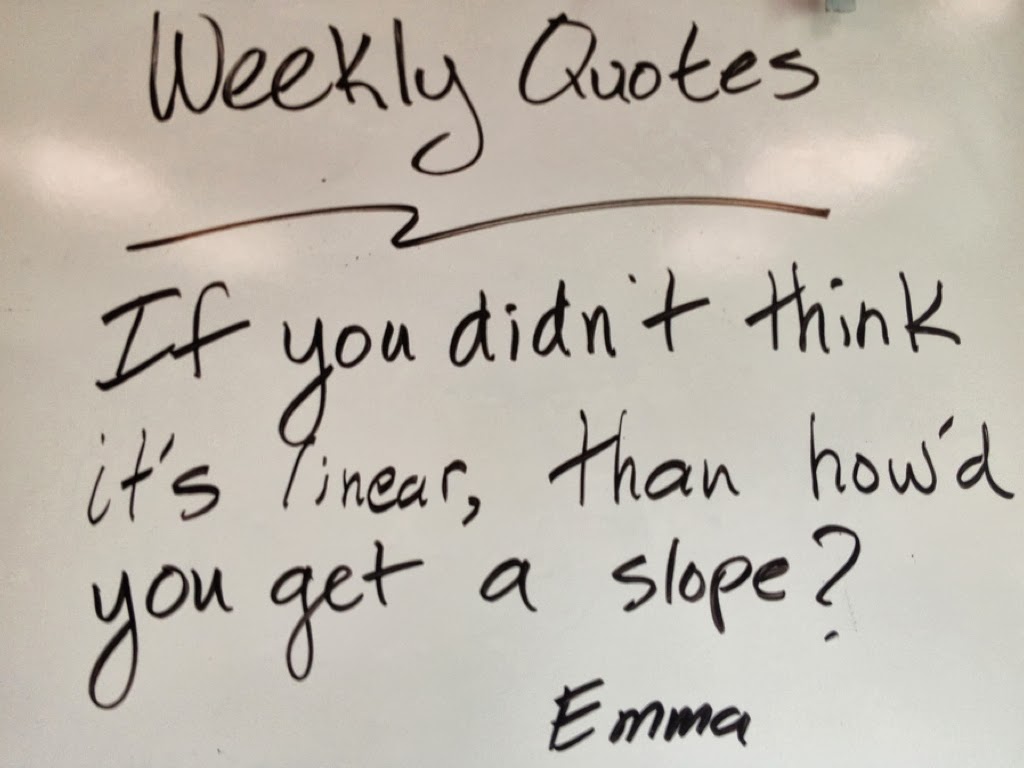
I experimented with Kelly O'Shea's Mistake Game in Algebra about midyear. Emma is presenting to the class about identifying linear functions, given three points. Justin (from the audience) claims that Emma’s graph is NOT linear, but says there's a slope to her three points. Without skipping a beat, Emma unleashed this response at Justin. Way to go Emma! Talking smack with math vocabulary.

Students were exploring x- and y-intercepts using Desmos.com. After graphing a few lines and writing down the ordered pairs of each intercept, the wheels started to turn inside of Lisa's head. She saw the structure and pattern of the intercepts containing zero. The follow-up:
Me: So Lisa, why are you seeing all these zeros?
Lisa: Because we're learning about intercepts today. 
Me: What are the intercepts of the lines? 
Lisa: It's where the lines hit the x or y axis. 
Me: So what's up with all the zeros? 
Lisa: If it hits the x-axis, the y value is zero. And if it hits the y-axis, the x value is zero. 
Me: Bingo! 
Mark needed to graph a straight line as part of his task. That week, we had just spent an entire class period doing a Jigsaw activity so that the students could explore the 8 Standards for Mathematical Practice. Mark is proud to be using Mathematical Practice 5, Use Appropriate Tools Strategically.

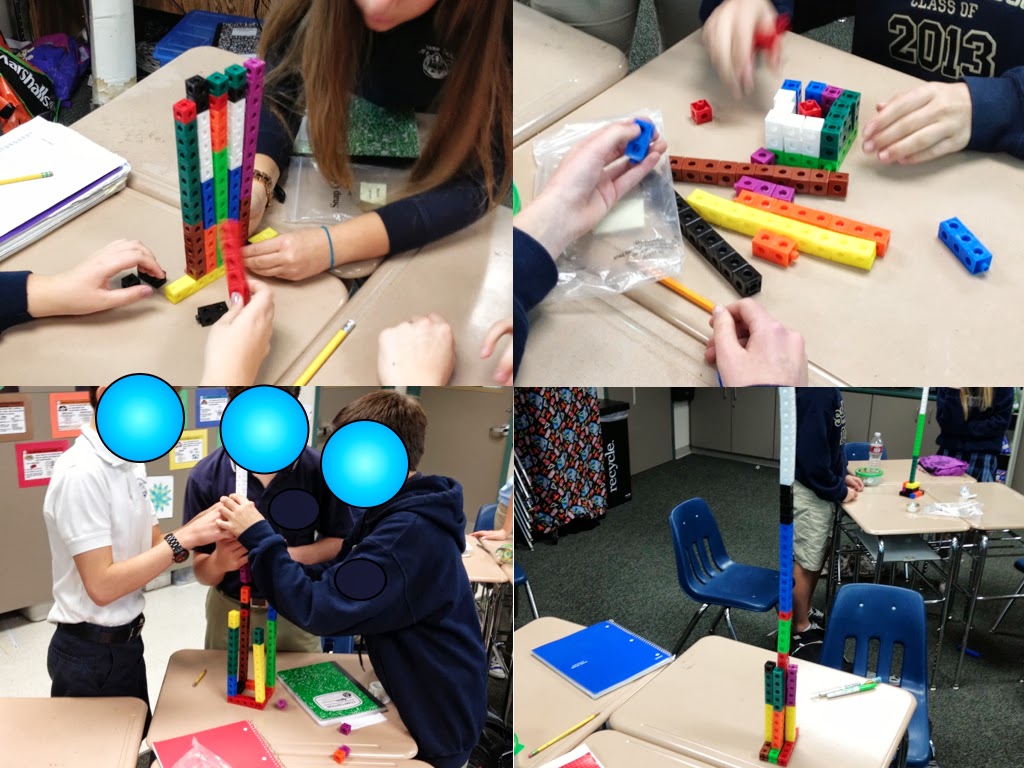
Groups were given a warm-up one day where they had to collaborate and stack the highest and strongest tower using 100 snap cubes. I determined the winners by kicking the desks they stood on to see who survived Earthquake Stadel the best. While cleaning up, Logan is noticing that he could do a better job next time. This is exactly what we can do in the math classroom: learn from our mistakes, come up with a revised problem-solving plan, model, collaborate, and persevere.

The class was doing a cocktail of mixture problems one day. They were collaborating with their groups and one group had your typical coin question. Something along the lines of:
I have $9.75 from X amount of nickels and dimes. How many of each coin do I have?

Upon solving the question on their whiteboard, Sara quickly realizes that you can’t have 1.95 of a coin. She was the first to notice it and say something to her classmates about this contradiction. The group first tried looking for their mistake and then tried solving the question again. Good job girls!

Midyear, I showed all my classes the 1st Semester QOTW slides. For the first month following these slides, Charles was trying to turn every little thing he said into a quote just so he could be up on the board. As I've mentioned before, these can't be planned or contrived. These quotes just come out naturally in the regular happenings of classroom interactions.  Students were doing some individual work one day, and Charles actually let a good one slip out. He was still working individually on the task and didn’t want his efforts spoiled by someone blurting out the correct answer. How many times have we been there, either on the receiving end or the one ruining it for others?  

This is Jenna's response to the following video:

I asked the class for their interpretation of the video or any of the drawings? Was there a drawing they could relate with? Without blinking, Jenna says, "It's like graphing stories." I totally agree. It had been awhile since we explored graphing stories, so Jenna just confirmed what a great impact that concept had on her. Very cool! 

Arielle is a former QOTW winner. Students were exploring exponent rules by finding mistakes. Michael Pershan and I have done some extensive blogging about this. Anyway, we had reached the final day or two of learning through mistakes and Arielle raised her hand and shared this gem with everyone. It's a beautiful observation in my opinion about the importance of math mistakes, learning by making conjectures, and students coming up with the rules on their own instead of me spoon-feeding them. 

Two quotes in one class period! That's a first. We were playing Race Car Math and one of the review questions asked students to factor a polynomial. Eli, a boy a few words, caught his group-mate incorrectly factoring the polynomial. I love the “Dude!” part of his quote.
Also during Race Car Math that day, Kailey was so excited to be on the board after correctly graphing a parabola, following the flowchart we put up in class. Our class flowchart is shown.

Last, but not least, Chris closed out the year with, "I think my number lied to me." In geometry, we were reviewing volume of a sphere with questions similar to Nathan Kraft’s volume of a soccer ball task. Chris set up, and used the incorrect proportion when solving. When arriving at an unreasonable answer, he realized his numbers lied to him. Way to check for reasonableness!

It's truly been a pleasure having the QOTW section carved out on my whiteboard for student quotes. As far as I'm concerned, this will be a staple in my classroom for the remainder of my career. I look forward to next year's quotes!

QOTW,
717